Perimenopausal skin in your forties: the hormone story is only half of it
Skin starts to change years before periods stop, and most of what is written about it stops at oestrogen. The sleep and the stress that arrive at the same time can be worked on, and oestrogen cannot.

The word perimenopause has finally reached the people it describes. Searches for it have risen by half in a year, and the women arriving at this site through those searches are not asking about hot flushes. They are asking why the skin that was fine at thirty-eight is dry, dull and oddly reactive at forty-four, why spots have come back along the jaw, and why every product they trusted seems to have stopped working at once. I am forty-seven, so I know the questions from the inside.
The transition usually starts somewhere in the mid-forties and, on the best cohort data, lasts between four and eight years, longer for women who start it younger. Through those years oestrogen does not decline in a line. It swings, high one cycle and low the next, and the skin, which has oestrogen receptors in every layer, swings with it. The well-described part comes after: in the first five years past the final period, dermal collagen falls by an estimated thirty per cent, and by around two per cent a year after that, on biopsy studies from the 1980s that have been repeated often enough to trust the direction if not the decimal. The menopausal skin page covers that stretch. This article is about the years before it, which are messier and get less attention.
What fluctuating oestrogen does to skin
Oestrogen holds water in the dermis, keeps sebaceous glands in check and supports the fat and collagen that give the face its shape. When it drops in a given month, the skin loses water faster, feels tighter and looks flatter, and products that were fine sting; the tired, dull skin page describes that flat, tight month from the inside. As it recovers, the skin recovers with it, which is why the same serum can seem to work in March and fail in April. Underneath, the ratio between oestrogen and androgens shifts as oestrogen falls, and for some women that relative androgen excess brings back the jawline breakouts of their twenties and, less welcome, fine facial hair. A 2022 expert review in the menopause journal Climacteric lists dryness, itch, thinning, sagging and slower wound healing as the skin signature of the change, with the androgen effects alongside. None of it is imagined and none of it responds much to a new moisturiser, though a heavier one helps the dry months.
That is the part everyone writes about. It is also the part you cannot do much about without a prescription, and hormone therapy is not prescribed for skin alone.
Sleep and stress in perimenopause: the half you can change
The same years bring two other changes, sleep and stress, and on any given morning they have more effect on how skin looks than the hormone does.
The first is sleep. In the largest study of the transition, which followed 3,045 American women aged 42 to 52 for seven years, the odds of trouble falling asleep and of waking in the night rose steadily as women moved through perimenopause, tracking falling oestrogen and rising FSH, and rising sharply with night sweats. Broken sleep is close to universal in these years. That counts for skin because the deep, slow-wave sleep of the early night is when most growth hormone is released and when the skin does the bulk of its repair; nights that are short or fragmented cut into exactly that window. It also raises cortisol the following evening, which the cortisol article goes into, and evening cortisol is what keeps you awake the next night.
The second is stress, and the sheer amount of it. Women in their mid-forties are, statistically, at the point of maximum simultaneous responsibility: children who still need driving, parents who are starting to need help, work at its most demanding. Whether perimenopause itself raises cortisol is less clear than the wellness industry suggests; the Seattle study that followed 132 women through the transition for fifteen years found overnight cortisol tracked their hormones more than their stage or their stress scores. What is clear is that the stress is real and the sleep is worse, and the skin sits downstream of both. Stress slows barrier repair, in the exam-season study described elsewhere on this site, and thinner, drier perimenopausal skin has less margin to lose.
So at forty-four the mirror is showing oestrogen swinging, sleep breaking up and stress rising, all at once, and it is hard to tell which is doing what. Two of the three can be changed in the evening.
An evening routine for perimenopausal sleep and skin
The best trial of a non-drug approach to perimenopausal sleep is a 2016 study of telephone-delivered cognitive behavioural therapy for insomnia in 106 women with hot flushes. Six short calls over eight weeks cut insomnia scores by twice as much as menopause education alone, and the gain held at six months. It did not reduce the flushes, but it reduced how much they wrecked the night. What I take from it is that the sleep problem of these years is partly a learned one, a bed that has become a place of lying awake, and that it responds to structure: the same wind-down, the same time, a routine that ends on its own.
In practice, for me, that has meant a fixed twenty minutes with headphones on before the light goes off, a heavier cream than I used to want, and the acids and retinoids put away in the dry weeks rather than pushed through. Paced breathing on its own, for what it is worth, did nothing for hot flushes in a decent-sized trial, so I would not promise you that. As the first ten minutes of a wind-down it is another question, and the breathing evidence is solid.
Skin will change through these years whatever you do. What you can influence is how much of the change comes from oestrogen, which you cannot move, and how much from four hours of sleep and a cortisol rhythm that has come loose, which you can. In my experience the second part is bigger than it looks at the time, and it is the part a new cream cannot reach.
For the broken nights, an hour that descends from 7.83 Hz to delta and switches its own screen down.
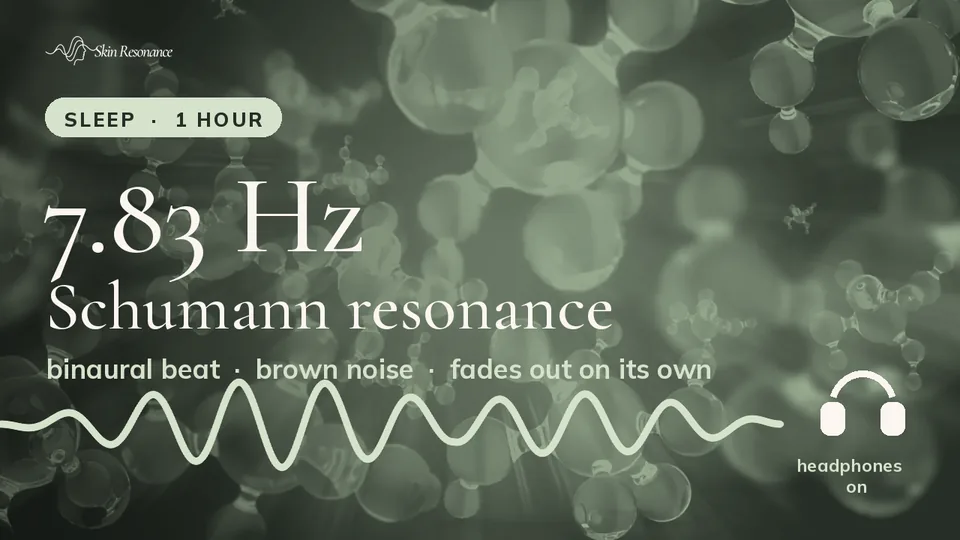
7.83 Hz sleep track: Schumann, then theta, then delta
An hour for bedtime. Fifteen minutes at 7.83 Hz, twenty at 4 Hz theta, twenty-five at 2 Hz delta, over a quiet bed of brown noise, the app's own sound engine. The screen dims after five minutes.
Watch on YouTube →Sources & further reading
- Paramsothy P, Harlow SD, Nan B, et al. Duration of the menopausal transition is longer in women with young age at onset: the multiethnic Study of Women's Health Across the Nation. Menopause 2017;24(2):142–149. PubMed
- Thornton MJ. Estrogens and aging skin. Dermato-Endocrinology 2013;5(2):264–270. PMC
- Brincat M, Versi E, Moniz CF, et al. Skin collagen changes in postmenopausal women receiving different regimens of estrogen therapy. Obstetrics & Gynecology 1987;70(1):123–127. PubMed
- Zouboulis CC, Blume-Peytavi U, Kosmadaki M, et al. Skin, hair and beyond: the impact of menopause. Climacteric 2022;25(5):434–442. PubMed
- Kravitz HM, Zhao X, Bromberger JT, et al. Sleep disturbance during the menopausal transition in a multi-ethnic community sample of women. Sleep 2008;31(7):979–990. PMC
- Woods NF, Mitchell ES, Smith-DiJulio K. Cortisol levels during the menopausal transition and early postmenopause: observations from the Seattle Midlife Women's Health Study. Menopause 2009;16(4):708–718. PubMed
- McCurry SM, Guthrie KA, Morin CM, et al. Telephone-based cognitive behavioral therapy for insomnia in perimenopausal and postmenopausal women with vasomotor symptoms: a MsFLASH randomized clinical trial. JAMA Internal Medicine 2016;176(7):913–920. PubMed
- Carpenter JS, Burns DS, Wu J, et al. Paced respiration for vasomotor and other menopausal symptoms: a randomized, controlled trial. Journal of General Internal Medicine 2013;28(2):193–200. PMC
- Garg A, Chren MM, Sands LP, et al. Psychological stress perturbs epidermal permeability barrier homeostasis. Archives of Dermatology 2001;137(1):53–59. PubMed
Elsewhere on the web
- NHS: menopause and perimenopause, symptoms, treatment and when to see a GP.
- British Menopause Society: patient factsheets, including sleep and skin.
- Balance: the free symptom-tracking app and library from the menopause specialist Dr Louise Newson.
Skin Resonance is a wellness web app, not a medical device, and does not diagnose, treat or cure any condition. For a diagnosed skin condition, please see a dermatologist.
Frequently asked
When does perimenopause start, and how long does it last?+
Usually in the mid-forties, sometimes earlier. On the largest cohort data the transition lasts four to eight years, longer for women who start it younger. Skin changes begin during it, not after.
Why does my skin react differently from month to month?+
Oestrogen swings rather than declining smoothly during perimenopause, and the skin, which has oestrogen receptors in every layer, swings with it: drier, tighter and more reactive in a low month, closer to normal in a high one. A heavier moisturiser and pausing acids in the dry weeks helps more than switching products.
Does perimenopause raise cortisol?+
Less clearly than is often claimed. The Seattle study that followed women for fifteen years found overnight cortisol tracked their hormones more than their stage or stress. What is well documented is that sleep breaks up through the transition, and short nights raise evening cortisol the next day.
What helps the sleep?+
Structure. The best non-drug trial in perimenopausal women used brief cognitive behavioural therapy for insomnia and halved insomnia scores without touching hot flushes. A fixed wind-down at the same time each night, ending on its own, is the home version. Skin Resonance's routines are built as that fixed window.