Somatic skincare: turning twenty minutes at the mirror into a nervous-system practice
Wellness has turned against measuring itself. For skincare that is good news, because the twenty minutes you already spend at the mirror is the most usable body-based practice most people have.

The word somatic has moved from therapists' offices to the mainstream in about two years. Searches for somatic therapy are up by more than a fifth on last year, and the Global Wellness Summit's report for 2026 listed nervous-system regulation as a leading trend alongside something it called the over-optimisation backlash, a turn away from rings, scores and streaks toward wellbeing you can feel rather than measure. Its phrasing was that wellbeing had become "something we perform correctly". I recognised that, and I recognised my own app in it, which was uncomfortable.
Somatic just means of the body. The therapies that carry the name, from trauma-focused work to the milder practices now on every yoga timetable, share one idea: that attention to bodily sensation, rather than to thoughts about the body, is a route into the nervous system that thinking cannot take. A 2018 paper describing one such approach, body-oriented mindful awareness therapy, sets out its stages plainly: learning to notice sensation, learning to stay with it, and learning to read what it is telling you. The evidence for the clinical versions is growing and mixed, as it is for most psychotherapy. The claim I want to make is smaller: for most people the evening skincare routine is already a somatic practice, and they have not noticed.
The psoriasis and mindfulness trial
The study I keep coming back to is from 1998, and it is the clearest demonstration I know that the state of the mind changes how skin responds to treatment. Jon Kabat-Zinn and colleagues at the University of Massachusetts took 37 people with moderate to severe psoriasis who were having ultraviolet light therapy. Half listened to a guided mindfulness tape during each session in the light box; half had the light alone. Dermatologists who did not know which group was which rated their skin from photographs. The tape group cleared faster, reaching the halfway point and full clearing significantly sooner, under both kinds of light. It was thirty-seven people at a single site nearly thirty years ago, never repeated at scale. Even so, it was the same treatment and the same skin disease, and the people who spent the session attending to their breath rather than their phone healed sooner.
The mechanism they proposed is the one this site is built on. Stress drives inflammation through cortisol and the sympathetic nervous system; psoriasis is an inflammatory disease; a calmer patient is a less inflamed one, and the light has less to fight. The exam-season study from 2001, in which students' skin barriers repaired more slowly during finals, is the same finding from the other side, in people with no disease at all.
Why your skincare routine is already somatic
Look at what most people do in the last half hour of the day. They stand at a basin, run warm water over their face, and spend several minutes moving their hands slowly over their own skin with attention. Usually they are alone, in a small room, with the door closed. It is the only point in the day when many adults touch their own face deliberately, and it is very close to what a somatic practitioner would prescribe, without the name.
Touch is the first element, and it has its own evidence. In a 2009 study, twenty adults received fifteen minutes of massage at either moderate or light pressure; moderate pressure shifted heart rate variability toward the parasympathetic state, light pressure did not. A therapist's hands are not your own, but the finding suggests that firm, slow strokes of the kind that spread a cream properly do more for the nervous system than the light dab most of us use. Warmth is the second: warm water on the face is comfortable, and comfort itself calms the body; the evening routine order article covers what goes on when. Breath is the third, and the evidence for slow exhalation is the strongest on the site. Sound, if you want it, is the fourth, and headphones make the bathroom a sealed room in a way a closed door does not; the sound healing article covers what the sound itself has been shown to do.
How to turn skincare into a somatic practice
The change from routine to practice is mostly a change of attention, and it needs a shape. Give it a fixed length; the app uses twenty minutes because it is long enough for the body to settle and short enough to survive a school night. Do it at the same point in the evening, after the children are down or the kitchen is clear, whichever marker is reliable in your house. Make the strokes slower and firmer than you would naturally, and follow them with your attention rather than with a plan for tomorrow. Breathe out for longer than you breathe in while the serum goes on. If you use a red-light mask or a microcurrent device, the minutes under the mask are the easiest place in the whole day to do nothing on purpose, and they are usually spent scrolling.
None of this requires a product you do not own. It requires deciding that the twenty minutes is for the nervous system and letting the skin benefit from that, which is the reverse of how most people think of it and, on the evidence above, the more accurate way round.
How long a new evening habit takes to form
The most-quoted figure is from a 2010 study at University College London, in which 96 volunteers chose a daily behaviour and logged how automatic it felt for twelve weeks. The median time to reach the point where it ran without effort was 66 days, and the range was 18 to 254. Half the participants' data could not be fitted to the curve at all. So the fair reading is that a new evening practice takes somewhere between three weeks and most of a year to stop being a decision, and that missing a night made no measurable difference to the outcome. That is the permission most people need. The practice is not broken because Thursday was a disaster.
The backlash against optimisation is right about the scores, and it goes wrong if calm becomes another thing to get right. Twenty minutes, warm water, slow hands, a long breath out, a sound if you like one, at the same time each night, for as many nights as you manage. The psoriasis patients in the light box did not know they were regulating anything. They were listening to a tape and breathing, and their skin cleared faster.
A ten-minute version of the container this article describes, to play while you do the routine.
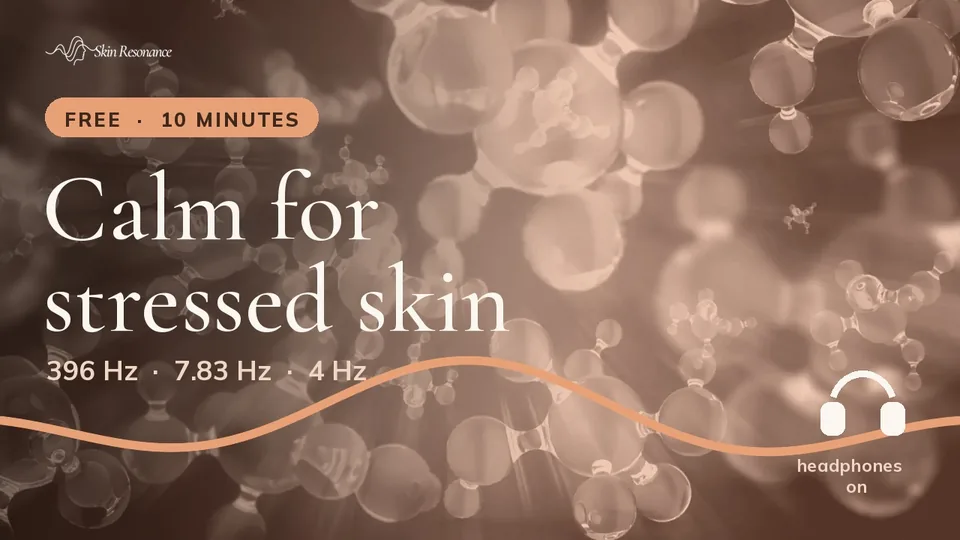
Calm for stressed skin: the free 10-minute routine
The same routine as the free try page, on YouTube: 396 Hz to settle, 7.83 Hz Schumann, then 4 Hz theta. Headphones on for steps 2 and 3.
Watch on YouTube →Sources & further reading
- Global Wellness Summit. The Future of Wellness 2026: The Rise of Neurowellness; The Over-Optimization Backlash. globalwellnesssummit.com
- Price CJ, Hooven C. Interoceptive awareness skills for emotion regulation: theory and approach of Mindful Awareness in Body-oriented Therapy (MABT). Frontiers in Psychology 2018;9:798. PubMed
- Kabat-Zinn J, Wheeler E, Light T, et al. Influence of a mindfulness meditation-based stress reduction intervention on rates of skin clearing in patients with moderate to severe psoriasis undergoing phototherapy (UVB) and photochemotherapy (PUVA). Psychosomatic Medicine 1998;60(5):625–632. PubMed
- Garg A, Chren MM, Sands LP, et al. Psychological stress perturbs epidermal permeability barrier homeostasis. Archives of Dermatology 2001;137(1):53–59. PubMed
- Diego MA, Field T. Moderate pressure massage elicits a parasympathetic nervous system response. International Journal of Neuroscience 2009;119(5):630–638. PubMed
- Laborde S, Allen MS, Borges U, et al. Effects of voluntary slow breathing on heart rate and heart rate variability: a systematic review and a meta-analysis. Neuroscience & Biobehavioral Reviews 2022;138:104711. PubMed
- Lally P, van Jaarsveld CHM, Potts HWW, Wardle J. How are habits formed: modelling habit formation in the real world. European Journal of Social Psychology 2010;40(6):998–1009. Wiley
Elsewhere on the web
- Global Wellness Summit: The Over-Optimization Backlash, the 2026 trend piece quoted above.
- Frontiers in Psychology: the MABT paper in full, if you want the clinical version of body-based attention.
- The free 10-minute routine on YouTube, a ready-made container for the practice described here.
Skin Resonance is a wellness web app, not a medical device, and does not diagnose, treat or cure any condition. For a diagnosed skin condition, please see a dermatologist.
Frequently asked
What does "somatic skincare" mean?+
Treating the evening routine as a body-based nervous-system practice rather than a product-application task: fixed length, slow firm touch, warm water, a long out-breath, attention on sensation. The skin benefits because a calmer body runs lower cortisol and inflammation, which is the state it repairs in.
Is there evidence the mind changes how skin responds?+
The clearest is a 1998 trial of 37 psoriasis patients having light therapy: those who listened to a mindfulness tape during sessions cleared significantly faster than those who had the light alone, as rated by blinded dermatologists. It is small and old, and it has not been repeated at scale.
Do I need special products or tools?+
No. Firmer, slower strokes when applying what you already own, warm water, and a longer exhale are the working parts. Headphones and a routine with sound help seal the twenty minutes off from the rest of the evening, which is what the app is for, and are optional.
How long until it feels automatic?+
In the habit-formation study most often cited, a median of about 66 days, with a range from 18 to 254 and wide individual variation. Missing a night made no measurable difference to whether the habit formed.