Vagus nerve skincare: what the evidence supports, and how to use it at home
The longest nerve in the body has become a skincare ingredient. The practices with the best evidence behind them are simple, free, and easy to build into an evening.

If you have bought a face product in the last year you may have been told it was formulated for your vagus nerve. There are oils that claim to "activate" it through the skin, gua sha kits that promise to stimulate it, and at least one moisturiser that describes itself as vagal. I run a company that sells calm for skin, so I am not a neutral party, and I am glad the nerve is finally being talked about. The nerve is real and so is its effect on skin. The part worth knowing is which practices reach it, because the ones that do are simpler than a serum.
The vagus is the tenth cranial nerve. It leaves the brainstem, runs down either side of the neck behind the carotid artery, and branches into the heart, lungs, gut and most of the organs in between. This is the main wire of the parasympathetic system, the state in which heart rate falls, digestion runs, and tissue, including skin, gets on with repair. The measure researchers use for how active it is is heart rate variability, the small beat-to-beat changes in timing that go up when the vagus is doing its job and flatten when the body is braced. When people talk about "vagal tone" they mean roughly this: how easily the body drops back into rest once a threat has passed.
The skin connection is indirect and it is the same one that runs through this whole site. Chronic stress keeps cortisol and inflammatory signalling raised, which slows barrier repair and keeps blemishes angry, as the cortisol article sets out; anything that reliably shifts the body toward the parasympathetic state gives the skin a better environment to work in. The question with any "vagus nerve" product or practice is simply whether it produces that shift, and whether anyone has measured it.
Vagus nerve practices with evidence: slow breathing, humming and cold
The practice with the best support is slow breathing. A meta-analysis published in 2022 pooled 223 studies of voluntary slow breathing, typically around six breaths a minute with the out-breath longer than the in-breath, and found that heart rate variability rose during the breathing, immediately after a single session, and after training programmes lasting weeks. Breathe in through the nose for four, out for six or eight, for five minutes, and the measure that researchers use to track the vagus moves in the right direction. Part of the during-breathing effect is mechanical, because slow breathing itself swings the heart rate, which the authors are careful to say; the changes measured after the session and after training are the ones that count, and they held.
Humming is slow exhalation with vibration added, and the humming article covers what is known. In a 2023 pilot with 23 people wearing heart monitors, humming produced a lower stress index than sleep, physical exercise or emotional stress. It is a small uncontrolled study and should be read as a promising signal rather than proof, but it agrees with everything else in the breathing literature.
The second practice with evidence is cold, and specifically cold on the face and neck. Mammals have a reflex that slows the heart when the face meets cold water, the dive reflex, and it runs partly through the vagus. A randomised trial in Luxembourg in 2018 applied a cold probe for sixteen seconds at a time to the lateral neck, the cheek and the forearm of 61 healthy adults. Cold on the side of the neck produced the largest drop in heart rate and the largest rise in heart rate variability. The effect lasts seconds to a minute, and the study used a laboratory probe, not a basin, so I would call it a well-described reflex rather than a treatment. Even so, a cold flannel held against the side of the neck for half a minute does something measurable, and it costs nothing.
Ice rollers and the frozen spoons that circulate as de-puffing tips fall into the same bucket. They move fluid and trigger the same brief reflex. The effect was there long before anyone sold a roller for it.
There is now a category of devices that stimulate a branch of the vagus in the ear with a small current, and these have real trials behind them. A Leeds group in 2019 ran three studies in adults over 55 and found that fifteen minutes a day of stimulation at the tragus, the little flap at the front of the ear, improved autonomic balance over two weeks and, in the people who started most sympathetically driven, improved mood and sleep as well. This is an actual intervention on the actual nerve. It is also a medical-adjacent device, the trials were in older adults, and none of them measured skin. I mention it because it shows that the nerve can be reached and measured, and because the home practices in this article move the same measure without a device.
Facial gua sha, oils and serums: what the research says
I went looking for any study of facial gua sha and vagal tone or heart rate variability. There is none yet. Two small studies from one group in Thailand scraped the backs of male weightlifters and reported modest changes in heart rate variability afterwards; they are body treatments in athletes, with contested measures, and they say nothing about a jade tool on the cheek. That does not count against facial gua sha. Moderate-pressure touch does shift the body toward the parasympathetic state, in a 2009 study of twenty adults receiving fifteen minutes of massage, and slow strokes down the neck may well work the same way. The mechanism is touch and pressure, the same as a hand, which is a good reason to use the tool slowly rather than briskly; the claim that it reaches the nerve through the skin has not been tested.
Oils and serums work differently from how the labels suggest. The vagus nerve does not have endings in the epidermis that a cream can reach; its sensory branches sit in the ear canal, the throat and the organs. What a product described as vagal offers is its scent, its texture and the slow minute you spend applying it, and those parts do make a difference. If you enjoy the minute with a particular bottle, the enjoyment is doing the work, and it is real; any oil you already own can do the same if you slow the minute down.
How the evening routine uses this evidence
The evening routines in the app were built on this reading of the evidence, before the phrase "vagus nerve skincare" existed. Headphones on, a sustained low tone, a long slow out-breath while it plays, and a fixed twenty minutes so the body learns the shape of it; the somatic skincare article lays the twenty minutes out. In winter I add a cold flannel on the side of the neck for the first half-minute. None of that comes in a jar. All of it moves the measure the studies use, and the skin benefits indirectly, as it always does.
The interest in the nerve is good news for skin, because the practices that reach it are the ones anyone can do tonight: a longer out-breath, a hum, a cold flannel, slow hands, and a stretch of steady sound. The app exists to hold those together for twenty minutes so you do not have to think about them.
The sustained low tone and the long out-breath, together, for ten minutes.
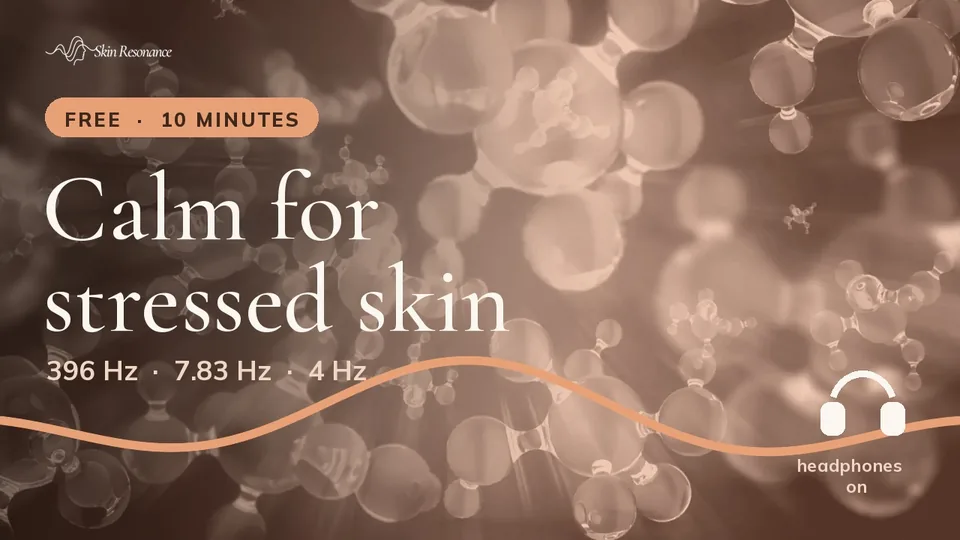
Calm for stressed skin: the free 10-minute routine
The same routine as the free try page, on YouTube: 396 Hz to settle, 7.83 Hz Schumann, then 4 Hz theta. Headphones on for steps 2 and 3.
Watch on YouTube →Sources & further reading
- Laborde S, Allen MS, Borges U, et al. Effects of voluntary slow breathing on heart rate and heart rate variability: a systematic review and a meta-analysis. Neuroscience & Biobehavioral Reviews 2022;138:104711. PubMed
- Trivedi G, Sharma K, Saboo B, et al. Humming (simple Bhramari pranayama) as a stress buster: a Holter-based study to analyze heart rate variability parameters. Cureus 2023;15(4):e37527. PMC
- Jungmann M, Vencatachellum S, Van Ryckeghem D, Vögele C. Effects of cold stimulation on cardiac-vagal activation in healthy participants: randomized controlled trial. JMIR Formative Research 2018;2(2):e10257. PMC
- Bretherton B, Atkinson L, Murray A, et al. Effects of transcutaneous vagus nerve stimulation in individuals aged 55 years or above: potential benefits of daily stimulation. Aging 2019;11(14):4836–4857. PMC
- Wang X, et al. Guasha improves the rating of perceived exertion scale score and reduces heart rate variability in male weightlifters: a randomized controlled trial. Journal of Traditional Chinese Medicine 2017;37(1):49–56. PubMed
- Diego MA, Field T. Moderate pressure massage elicits a parasympathetic nervous system response. International Journal of Neuroscience 2009;119(5):630–638. PubMed
- Chen Y, Lyga J. Brain-skin connection: stress, inflammation and skin aging. Inflammation & Allergy Drug Targets 2014;13(3):177–190. PMC
Elsewhere on the web
- Houston Methodist: can stimulating your vagus nerve really relax you?, a hospital's plain-language take on the trend.
- The Conversation: why activating your vagus nerve has become the latest wellness trend, written by researchers in the field.
- The free 10-minute routine on YouTube, which pairs a long exhale with a low tone.
Skin Resonance is a wellness web app, not a medical device, and does not diagnose, treat or cure any condition. For a diagnosed skin condition, please see a dermatologist.
Frequently asked
Can a serum or face oil stimulate the vagus nerve?+
Not through the skin. The nerve's sensory endings are in the ear canal, the throat and the internal organs, not the surface of the face. The slow minute you spend applying something you like does calm you, through touch and the pause, and that is worth keeping.
Does facial gua sha activate the vagus nerve?+
No study has tested facial gua sha on vagal tone or heart rate variability. Moderate-pressure touch does shift the body toward the parasympathetic state, so slow strokes down the neck may help in the way a hand would. Used slowly, it is a good part of a wind-down.
What does have evidence?+
Slow breathing with a longer out-breath, in a meta-analysis of 223 studies; humming, in small pilots; cold on the side of the neck or face, which triggers a brief heart-slowing reflex; and, in a medical setting, electrical stimulation of the ear in trials with older adults.
How does any of this reach my skin?+
Indirectly. A body that drops back into its rest state more easily runs lower cortisol and inflammation, and skin repairs its barrier and clears blemishes faster in that environment. The skin benefit is real, and it is one step removed from the nerve.