Nervous system regulation skincare: what it is, and how to do it at home
Nervous system regulation is the skincare step almost no one talks about. Calm the body and everything you put on your face gets a better chance to work.

You have probably tried the serums and the actives, the ten-step routine and the stripped-back three-step one. The shelf looks good, and some weeks your skin still does not match it.
Nervous system regulation is the skincare step almost no one talks about. When your body is stuck in sympathetic dominance (fight or flight) rather than cycling into parasympathetic calm (rest and repair), your skin shows it. Cortisol stays elevated, blood flow to the skin narrows, collagen production slows, the barrier weakens and inflammation runs higher than it should. A serum can only do so much against that, and the good news is that the calm state is something you can reach for.
The wellness world has started calling this nervous system skincare: treating your skin by treating the autonomic state it lives in, not just the surface you apply products to.
What is nervous system regulation?
Your autonomic nervous system runs the background functions of your body: heart rate, digestion, blood flow, hormone release, immune response. It has two main branches, the sympathetic system, which readies you for action, and the parasympathetic system, which restores you during rest. A well-regulated nervous system moves between the two as the day asks, spending most of its time in parasympathetic mode and shifting into sympathetic activation only when something calls for it.
A dysregulated nervous system gets stuck. Most of us live in a mild but persistent state of sympathetic activation, kept there by work stress, phone use, poor sleep, bright light at night, caffeine and a general sense of low-grade urgency that never quite resolves. Cortisol sits slightly high all day, heart rate variability drops and vagal tone weakens, so the body stops switching into repair mode the way it is designed to.
Nervous system regulation is the practice of actively shifting your body back into parasympathetic dominance, raising heart rate variability, strengthening vagal tone, and giving your physiology the signal that it's safe to rest and repair.
Why your skin cares about your nervous system
Skin responds to every hormonal, vascular and immune shift happening underneath it, so when your nervous system is dysregulated the effects show up in the skin in four specific ways.
1. Cortisol stimulates oil production and inflammation
Sebaceous glands have receptors for stress hormones. Chronic cortisol elevation triggers excess sebum, weakens the skin barrier, and pushes the immune system into a low-grade inflammatory state. This is the mechanism behind stress breakouts, and it's also behind a lot of redness, sensitivity, and reactivity that people blame on products.
2. Sympathetic activation constricts dermal blood flow
In a sympathetic state, blood is redirected away from the periphery and toward the large muscle groups. Your face and limbs get less circulation, which means less oxygen and fewer nutrients reaching the skin cells that build and repair tissue. Dull, flat, tired skin often has more to do with circulation than with anything you are putting on it, and circulation is one of the first things the calm state restores.
3. Cortisol suppresses collagen synthesis
Collagen is built by fibroblasts, and fibroblast activity depends on a hormonal environment that chronic cortisol actively undermines. Research has shown cortisol directly suppresses type I collagen production. Meanwhile, the largest pulses of growth hormone, which drives collagen synthesis, are released during slow-wave sleep. A dysregulated nervous system tends to sleep badly, so collagen production takes a hit from both directions.
4. Stress impairs barrier recovery
A healthy skin barrier repairs itself overnight. Studies have shown that psychological stress measurably delays this barrier recovery, leaving skin more reactive, more dehydrated and more vulnerable to environmental triggers the next day. This is why a stressful week so often shows on your face the following morning, and why a calmer evening is such a good investment.
Where topical skincare stops and nervous system skincare begins
For years, skincare has been built around topical intervention: better actives, stronger formulations, smarter delivery. That approach works well when the limiting factor is at the surface. When the limiting factor is systemic (cortisol, circulation, sleep architecture, inflammation), a topical can only reach so far, and the rest has to come from inside.
Wellness culture is ahead of skincare culture on this. Vagus nerve stimulation, cold exposure, breathwork, heart rate variability training and sleep tracking are all nervous system regulation tools, and many people already use them for general health. What is less often noticed is that these same practices change the physiological conditions the skin operates in.
Nervous system skincare is the bridge between these two worlds. The practices the wellness community has been refining for nervous system health are also the missing layer in a serious skincare routine.
How to regulate your nervous system for better skin
You cannot force parasympathetic dominance, but you can create the conditions that make it more likely and practise the specific inputs that move your body toward it. These are the ones I rely on most.
Slow-paced breathing
Slow breathing, particularly with extended exhales, is one of the fastest-acting nervous system regulation tools available. A few minutes of 4-in, 8-out breathing shifts heart rate variability, lowers cortisol, and activates the vagus nerve. It costs nothing and works within minutes. Use it before bed, during stressful moments, or at the start of your skincare routine.
Protect your sleep architecture
Sleep is when the nervous system does its deepest regulation work. Growth hormone pulses during slow-wave sleep, cortisol drops, barrier repair runs, and parasympathetic tone is strongest. Fragmented or late sleep compresses all of this. A consistent bedtime, a cool dark room, no phone in bed and no alcohol within three hours of it. None of this is glamorous advice, but it is the single biggest lever you have for nervous system health.
Reduce morning and evening phone use
The first and last inputs of the day shape your autonomic state more than people realise. Checking your phone on waking spikes cortisol at a time when a gentle rise would serve you better. Scrolling before bed suppresses melatonin and primes sympathetic activation right when you need the opposite. Replacing these two windows with calm input (breathwork, sound, stillness) shifts the nervous system's baseline.
Cold exposure
Brief cold exposure, such as a cold splash to the face or a cold shower, triggers a parasympathetic rebound after the initial sympathetic spike. Regular exposure trains the nervous system to recover from activation more quickly. Facial blood flow also increases as the vessels dilate in response.
Sound frequencies and auditory entrainment
Specific sound frequencies (binaural beats in the theta range, solfeggio tones, slow-tempo soundscapes) have been associated with measurable reductions in cortisol and increases in heart rate variability in several small studies. The studies so far are small and the quality of evidence is low, so I would call the effects modest rather than proven, but they point the same way and the cost of trying is close to nothing. As an addition to a nervous system regulation practice, sound is one of the most accessible entry points there is. It asks for no skill, no equipment beyond headphones, and no effort beyond pressing play.
Skin Resonance is built around exactly this idea, nervous system regulation as a skincare step. It has thirteen concern-based routines of guided sound frequencies to listen to while you do your evening skincare, designed to support parasympathetic activation, lower cortisol and help your skin move from reactive to repairing. There is a free ten-minute routine if you would like to feel the difference for yourself.
Why nervous system calm changes what your skincare can do
Nervous system skincare is what happens when wellness knowledge about the autonomic nervous system meets clinical knowledge about what the skin needs in order to function well. Regulation practices create the conditions in which skin can do what it already knows how to do, which is repair, protect and renew itself, and the route from a calmer body to better skin (lower cortisol, less inflammation, better overnight repair) is well documented.
If you have been treating your skin for years and something still feels off, the answer may lie past the surface, in the autonomic state your skin is trying to function within. Give the body some calm each evening and the products you already own get a fairer chance to work.
For more on the specific mechanisms, read our article on how cortisol triggers acne, or our piece on what to do during a red light mask session.
Ten minutes of this is the quickest way to feel the shift the article describes.
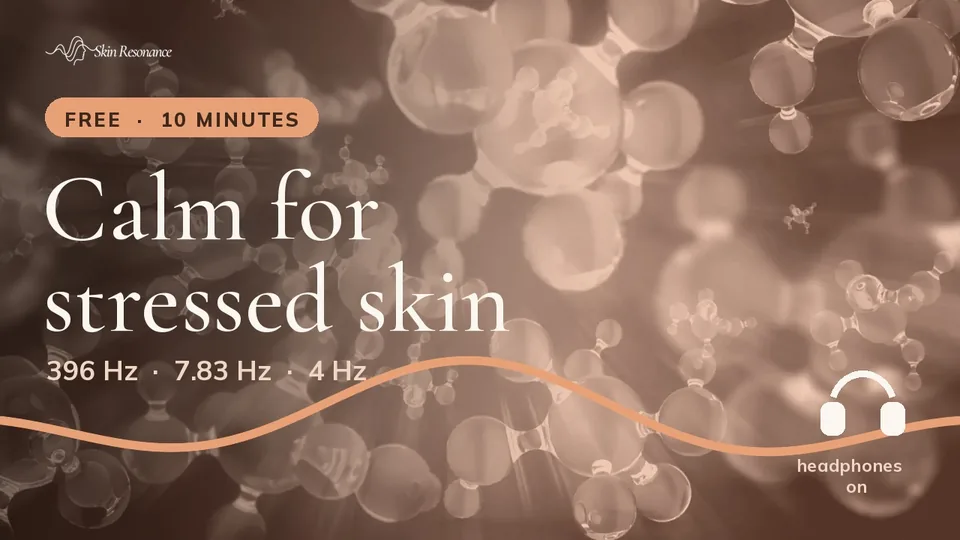
Calm for stressed skin: the free 10-minute routine
The same routine as the free try page, on YouTube: 396 Hz to settle, 7.83 Hz Schumann, then 4 Hz theta. Headphones on for steps 2 and 3.
Watch on YouTube →The same idea in the morning: alpha rather than theta, so you stay awake and settled while you massage a puffy face.
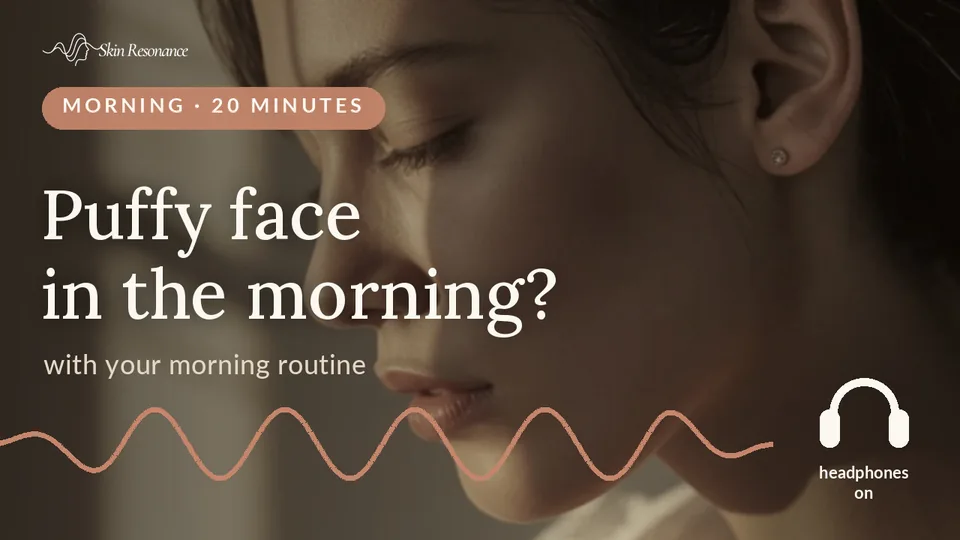
Puffy face in the morning: Schumann, then alpha, then 285 Hz
Twenty minutes for a puffy morning. Six at 7.83 Hz with something cool on the face, ten at 10 Hz alpha for massage with whatever you use, four at 285 Hz for serum and SPF. Headphones on for the first two stages.
Watch on YouTube →Sources & further reading
- Chiu, A., et al. (2003). The response of skin disease to stress: changes in the severity of acne vulgaris as affected by examination stress. Archives of Dermatology, 139(7). pubmed.ncbi.nlm.nih.gov/12873885
- Choi, E. H., et al. (2006). Stress-induced cortisol response impairs epidermal permeability barrier homeostasis. Journal of Investigative Dermatology. pubmed.ncbi.nlm.nih.gov/16902417
- Zaccaro, A., et al. (2018). How breath-control can change your life: a systematic review on psycho-physiological correlates of slow breathing. Frontiers in Human Neuroscience, 12:353. pubmed.ncbi.nlm.nih.gov/30245619
- Van Cauter, E., et al. (2000). Age-related changes in slow wave sleep and REM sleep and relationship with growth hormone and cortisol levels in healthy men. JAMA, 284(7). pubmed.ncbi.nlm.nih.gov/10938176
- Hirotsu, C., et al. (2015). Interactions between sleep, stress, and metabolism: from physiological to pathological conditions. Sleep Science, 8(3). pubmed.ncbi.nlm.nih.gov/26779321
Skin Resonance is a wellness web app, not a medical device, and does not diagnose, treat or cure any condition. For a diagnosed skin condition, please see a dermatologist.
Frequently asked
What is nervous system regulation?+
Nervous system regulation is the practice of shifting your body from sympathetic dominance (fight or flight) into parasympathetic activation (rest and repair). It involves raising heart rate variability, strengthening vagal tone, and giving your physiology the signal that it's safe to rest and restore.
How does the nervous system affect your skin?+
When your nervous system is stuck in sympathetic activation, cortisol stays elevated, which stimulates oil production and inflammation. Blood flow to the skin constricts, so less nourishment reaches it, collagen synthesis is suppressed, and barrier recovery slows, leaving skin more reactive and dehydrated. These four mechanisms explain stress breakouts, dullness, sensitivity and accelerated ageing.
What is nervous system skincare?+
Nervous system skincare is the approach of treating your skin by treating the autonomic state it lives in, not just the surface. It combines conventional topical skincare with practices that support parasympathetic activation, such as breathwork, sleep optimisation, and sound frequency routines, to create the internal conditions where skin can repair itself.
How do you regulate your nervous system?+
Slow-paced breathing with extended exhales activates the vagus nerve within minutes. Consistent sleep with a regular bedtime supports overnight regulation. Reducing phone use in the first and last thirty minutes of the day lowers cortisol at key points. Brief cold exposure triggers a parasympathetic rebound. Sound frequencies, including binaural beats, have been associated with cortisol reduction and increased heart rate variability.
Can cortisol cause skin problems?+
Yes. Chronic cortisol elevation stimulates sebaceous glands to overproduce oil, weakens the skin barrier by disrupting ceramide production, pushes the immune system into a low-grade inflammatory state, and suppresses collagen synthesis. It also impairs overnight barrier recovery, leaving skin more vulnerable the following day.