Stress, cortisol and acne: the mechanism, and what the evidence shows
Yes, stress causes breakouts, and the mechanism is cortisol. Here is exactly how it happens, and how to interrupt the cycle.

You had a stressful week, with a deadline, a difficult conversation and a few bad nights of sleep, and now your skin is breaking out. The timing feels like confirmation of something you already suspected, which is that stress and breakouts are connected.
Yes, stress causes breakouts. When you're stressed, your body releases cortisol, which stimulates your skin's sebaceous glands to produce more oil, weakens the skin barrier, and triggers inflammation. That combination of excess oil, impaired barrier, and inflamed skin is the environment in which acne forms. Breakouts usually appear a few days after the stressful event, not during it.
This is the cortisol-acne connection, and once you understand the chain of events, it becomes easier to interrupt.
How cortisol triggers acne
Cortisol is the body's main stress hormone. The adrenal glands produce it when your brain perceives a threat, and in short bursts it is very useful. The trouble comes with the steady low elevation most of us live with, from work pressure, poor sleep, constant phone use and a background hum of anxiety. That kind of cortisol never quite switches off, and the skin feels the effects.
1. Cortisol increases oil production
Sebaceous glands have receptors for stress hormones. When cortisol and corticotropin-releasing hormone (CRH) bind to those receptors, sebum production goes up. Research published on human sebocyte cultures has documented how CRH directly stimulates lipid production in sebaceous gland cells, providing a clear mechanism for stress-related oily skin. More oil means more clogged pores, and a clogged pore is where a breakout begins.
2. Cortisol weakens the skin barrier
The outermost layer of skin is a barrier that holds moisture in and keeps irritants out. Chronic cortisol exposure disrupts that barrier by interfering with the production of ceramides and other lipids that hold it together. A weakened barrier loses water faster, reacts to products it normally tolerates, and lets bacteria penetrate more easily.
3. Cortisol fuels inflammation
In the short term cortisol is anti-inflammatory. When it stays high for weeks on end, the body's immune cells stop responding to it properly and it becomes pro-inflammatory instead. Inflammation amplifies every stage of acne formation: it makes clogged pores more likely to become inflamed papules, and it makes existing blemishes redder, more painful, and slower to heal.
4. Cortisol slows skin healing
Research on wound healing consistently shows that elevated cortisol delays repair. For acne-prone skin, this means the breakout you have today will take longer to clear than it would if your cortisol were lower. Post-inflammatory marks also linger longer.
Each of those four changes, the extra oil, the weaker barrier, the added inflammation and the slower healing, would tilt skin toward breakouts on its own. Together they explain why a hard fortnight so often shows up on the chin a few days later.
Why stress breakouts appear days after the stressful event
One of the most confusing things about stress breakouts is the delay. You get through the stressful week, things calm down, and then three or four days later your skin erupts, just when you thought you were in the clear.
Acne is a slow-forming process. A single breakout represents a sequence that started well before you could see it. Excess sebum gets produced, mixes with dead skin cells, and begins to clog a pore. Bacteria multiply inside the clogged pore. The immune system responds, inflammation builds, and eventually the spot becomes visible on the surface. From initial trigger to visible breakout typically takes two to seven days.
The spot you're looking at on Tuesday morning was set in motion the previous Thursday, in the middle of the stressful week. By the time it surfaces you've already moved on mentally, which is why the timing feels disconnected, when in fact your skin is simply running a few days behind your calendar.
The same delay explains why stress management works even though the results aren't immediate. Lowering cortisol today won't clear the breakouts already in progress, but it does mean fewer get started for next week, and that is where the improvement shows up.
Stress acne or hormonal acne: how to tell them apart
The two overlap more than the internet suggests, and the surest way to tell them apart is timing rather than location. Hormonal acne follows the cycle: in a survey of 400 women, 44 per cent reported a premenstrual flare, rising to 53 per cent among women over 33, and it arrives in the week before a period with a regularity you can mark on a calendar. Stress acne follows events instead, arriving in the days after the hard stretch on the lag described above, as a study of 22 university students found when acne severity rose with self-rated stress during examinations.
Location is a weaker clue than the jawline rule implies. In an international study of 374 adult women with acne, only 11.2 per cent had lesions confined to the jaw and chin, and almost 90 per cent had the same cheek, forehead and temple distribution as adolescent acne. Depth helps a little: cyclical acne tends toward deeper, tender nodules along the lower face, while stress breakouts are more often the inflamed papules and pustules that turn up wherever your pores are oiliest.
One more finding complicates the picture usefully. When researchers followed 94 Singapore adolescents through exam and holiday periods, acne severity tracked stress but sebum output did not change, which suggests stress works through inflammation and nerve signalling in the skin as much as through oil. That is one reason rest and sleep earn a place alongside a topical routine when a breakout is stress-led. The two kinds also feed each other, since a stressful month can disturb the cycle itself.
Where stress breakouts tend to appear
No study has mapped stress breakouts to a region of the face, and the face-mapping charts that assign the chin to hormones and the forehead to digestion have no evidence behind them. What is known is where the sebaceous glands are densest: the forehead, nose and chin carry several hundred glands per square centimetre, with the chest and upper back the next densest and the cheeks and limbs far behind. Cortisol and CRH act on those glands, so a stress breakout most often shows in the oily zones, on the chin and along the jaw, and on the back and chest in people who are prone there.
Habits that come with stress fill in the rest. A hand resting on the chin through a long call, a phone pressed to the cheek, a mask worn for a shift, shorter sleep and more sugar all add friction, bacteria or inflammation to skin that cortisol has already primed, and lowering the load while keeping the routine simple addresses the location and the cause at once.
How to break the cortisol-acne cycle
Nobody can remove stress from their life entirely, but you can lower your baseline cortisol and shorten the time your body spends in a stress response. These are the things that help most.
Prioritise sleep
Cortisol follows a daily rhythm that depends on good sleep. Too little sleep, or broken sleep, raises cortisol the next day and unsettles the rhythm for days afterwards. Aim for seven to nine hours, a consistent bedtime, a dark room and no phone in bed. It is not glamorous advice, but sleep is the single biggest lever you have on cortisol.
Use breathwork during high-stress moments
Slow-paced breathing shifts the nervous system from sympathetic to parasympathetic dominance within minutes. Box breathing (four in, four hold, four out, four hold) or extended exhales (four in, eight out) both work. Two to five minutes during a stressful moment interrupts the cortisol spike before it builds.
Reduce phone use before bed and on waking
Checking your phone first thing in the morning or last thing at night keeps cortisol elevated at times when it should be falling. The content doesn't even have to be stressful, because the rapid scanning, deciding and responding is enough on its own. A thirty-minute phone-free buffer at each end of the day changes the shape of the cortisol curve.
Adjust skincare for a compromised barrier
During stress-prone periods, keep your routine simple. Cut back on actives (retinoids, acids, strong exfoliants) and put the effort into barrier support instead, with a gentle cleanser, a ceramide-rich moisturiser and sunscreen. A compromised barrier reacts to products it would normally tolerate, and piling treatments onto a stress breakout usually makes it worse.
Use sound frequencies to support parasympathetic activity
Several small studies have linked specific sound frequencies with lower cortisol and higher parasympathetic activity. The studies are early and the effects modest, but they point in the right direction, and sound is one of the few calming tools that asks almost nothing of you. There is no technique to learn and no need to quiet your mind first. You put on headphones, and your nervous system has something steady to settle into while you get on with your evening.
Skin Resonance has a "Stressed, Breakout-Prone" routine built for exactly this situation. It is a twenty-minute evening routine of sound frequencies chosen to support cortisol regulation and parasympathetic activity, with a stage for your skincare built in, so the calming and the cleansing happen together. You can try it free tonight.
Try the Stressed, Breakout-Prone routine →
Why a calmer nervous system means fewer stress breakouts
Stress breakouts are not a personal failing or a sign that you're bad at handling pressure. They're a physiological response to a hormone your body is designed to produce, and you wouldn't want to stop producing it. What you want is to stop your body producing it constantly, at a low level, in response to things that never needed a stress response in the first place.
Skincare on its own can't do all of this, because even the most carefully chosen routine can't outpace a nervous system stuck on alert. Pair a calmer nervous system with a sensible routine and consistent sleep, though, and the conditions your skin is healing under change for the better. Lower cortisol means less oil, a steadier barrier and less inflammation, so fewer breakouts get started and the ones that do clear faster.
For more on the underlying science, read our cortisol and your complexion article, which covers the broader stress-skin connection in more detail.
The calm-the-system wind-down above, as sound: the free ten-minute routine for stressed, breakout-prone skin.
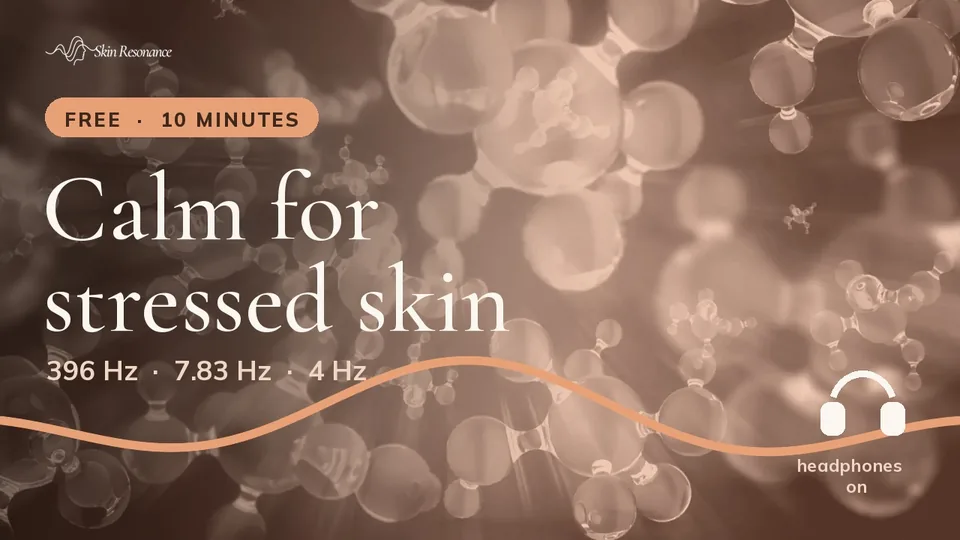
Calm for stressed skin: the free 10-minute routine
The same routine as the free try page, on YouTube: 396 Hz to settle, 7.83 Hz Schumann, then 4 Hz theta. Headphones on for steps 2 and 3.
Watch on YouTube →Sources & further reading
- Ganceviciene, R., et al. (2009). Involvement of the corticotropin-releasing hormone system in the pathogenesis of acne vulgaris. British Journal of Dermatology, 160(2). pubmed.ncbi.nlm.nih.gov/19067713
- Chiu, A., et al. (2003). The response of skin disease to stress: changes in the severity of acne vulgaris as affected by examination stress. Archives of Dermatology, 139(7). pubmed.ncbi.nlm.nih.gov/12873885
- Choi, E. H., et al. (2006). Stress-induced cortisol response impairs epidermal permeability barrier homeostasis. Journal of Investigative Dermatology. pubmed.ncbi.nlm.nih.gov/16902417
- Zaccaro, A., et al. (2018). How breath-control can change your life: a systematic review on psycho-physiological correlates of slow breathing. Frontiers in Human Neuroscience, 12:353. pubmed.ncbi.nlm.nih.gov/30245619
- Hirotsu, C., et al. (2015). Interactions between sleep, stress, and metabolism: from physiological to pathological conditions. Sleep Science, 8(3). pubmed.ncbi.nlm.nih.gov/26779321
- Stoll, S., et al. (2001). The effect of the menstrual cycle on acne. Journal of the American Academy of Dermatology, 45(6). pubmed.ncbi.nlm.nih.gov/11712049
- Dréno, B., et al. (2015). Large-scale international study enhances understanding of an emerging acne population: adult females. Journal of the European Academy of Dermatology and Venereology, 29(6). doi:10.1111/jdv.12757
- Yosipovitch, G., et al. (2007). Study of psychological stress, sebum production and acne vulgaris in adolescents. Acta Dermato-Venereologica, 87(2). doi:10.2340/00015555-0231
- Picardo, M., et al. (2009). Sebaceous gland lipids. Dermato-Endocrinology, 1(2). pubmed.ncbi.nlm.nih.gov/20224686
Skin Resonance is a wellness web app, not a medical device, and does not diagnose, treat or cure any condition. For a diagnosed skin condition, please see a dermatologist.
Frequently asked
Does stress cause breakouts?+
Yes. When you're stressed, your body releases cortisol, which stimulates sebaceous glands to produce more oil, weakens the skin barrier, and triggers inflammation. That combination of excess oil, impaired barrier, and inflamed skin is the environment in which acne forms.
Why do breakouts appear days after stress?+
Acne is a slow-forming process. Excess sebum clogs a pore, bacteria multiply, the immune system responds, and inflammation builds before the spot becomes visible. From initial trigger to visible breakout takes roughly two to seven days, which is why spots surface after the stressful period has already passed.
How does cortisol cause acne?+
Cortisol increases oil production by binding to receptors on sebaceous glands. It weakens the skin barrier by disrupting ceramide production. It fuels inflammation by desensitising immune cells. And it slows wound healing, so existing breakouts take longer to clear and post-inflammatory marks linger longer.
How do you stop stress breakouts?+
Lower baseline cortisol by prioritising seven to nine hours of consistent sleep, using slow-paced breathwork during high-stress moments, reducing phone use in the first and last thirty minutes of the day, simplifying skincare during stress-prone periods, and supporting parasympathetic activity through practices like sound frequency routines.
Should you change your skincare routine when stressed?+
Yes. During high-stress periods, the skin barrier is compromised and reacts to products it would normally tolerate. Cut back on actives like retinoids, acids, and strong exfoliants, and focus on barrier support: gentle cleanser, ceramide-rich moisturiser, and sunscreen. Piling treatments onto stressed skin usually makes things worse.
Is it stress acne or hormonal acne?+
Timing tells you more than location. Hormonal acne flares in the week before a period, month after month; stress acne follows a hard stretch by a few days. Cyclical acne tends toward deeper, tender nodules on the lower face, while stress breakouts are more often inflamed papules in the oiliest zones, though an international study of 374 adult women found only 11 per cent had acne confined to the jaw. The two also overlap, since a stressful month can disturb the cycle.