Sound healing at home: what the research supports, and how to do it
The trials on sound healing are small, and they point the same way: steady sound lowers anxiety and shifts the body toward rest. Here is what has been measured, and how to get the same twenty minutes at home.

A sound bath in a studio near me costs thirty-five euros and lasts an hour. You lie on a mat under a blanket while someone plays gongs and singing bowls over you, and most people leave saying they feel as if they have slept for a week. I have been to a few. As a composer I notice what a sustained low note does to a room full of bodies, and I built an app on the idea that you can have a version of that at home for the price of a takeaway. So bear that in mind when I say the research is still young, and also when I say that what exists is more consistent than most people expect.
The oldest usable evidence is about music rather than bowls. A 2020 review pooled 104 randomised trials with 9,617 participants in which people listened to music, chosen for calm, in stressful situations: before surgery, in intensive care, during procedures. Physiological stress measures fell by a small-to-medium amount, heart rate most clearly; anxiety and restlessness fell by a medium amount. A Cochrane review from 2013 looked at pre-operative anxiety alone and found music listening lowered it by about six points on the standard scale, comparable in one large trial to a sedative. These are not sound healing studies, but they establish what sound healing rests on: the nervous system responds to steady, chosen sound, and the response is large enough to measure in a hospital.
Singing bowl and sound bath studies
The studies of the instruments themselves are fewer and smaller. The one most often cited is from San Diego in 2017, where 62 adults filled in mood questionnaires before and after a single Tibetan singing bowl meditation. Tension, anger, fatigue and low mood all dropped, and people who had never done it before dropped further than the regulars. There was no control group, so the study cannot separate the bowls from an hour lying down in a quiet room, and the authors say so.
A Chilean trial from 2023 did add controls. Fifty anxious adults were randomised to a fifty-minute live singing bowl session, a progressive muscle relaxation session, or a waiting list. The bowl group showed the largest fall in state anxiety, a shift in their EEG toward a calmer pattern, and a rise in heart rate variability, which is the measure of parasympathetic activity that runs through everything on this site. There were sixteen people in the bowl group and one session, so it is a pilot, and a promising one. Two systematic reviews, one in 2020 and one in 2025, come to the same place from opposite directions: the first found four studies of low quality and called the evidence insufficient; the second found nineteen and said the practice "may have potential" for anxiety, low mood and sleep, with small samples and mixed methods throughout.
So something happens. It has been measured a few dozen times in a few hundred people, and the next step is a large trial that separates how much is the sound and how much is fifty minutes lying down with your phone in another room. Either way, the person on the mat gets the benefit.
Binaural beats: the best-studied part of sound healing
Binaural beats are the part of sound healing that has been studied most, because they are easy to standardise: play one frequency in the left ear and a slightly different one in the right, and the brain perceives a slow pulse at the difference. A 2019 meta-analysis of 22 studies found a medium-sized effect across anxiety, attention, memory and pain, larger when the beats played for longer and when they started before the task rather than during it. Theta-range beats, the four-to-seven-per-second pulses used in the deeper stages of the app, were the ones most associated with reduced anxiety; the noise and beats article explains how a beat differs from the noise it sits on. A 2023 review of the EEG studies found the picture on brainwaves themselves is unsettled: five studies saw the brain's rhythm follow the beat, eight did not, one was mixed. The relaxation effect is better supported than the brainwave explanation usually given for it, and I try to say so whenever I describe what the app does.
How sound healing reaches the skin
No study of bowls, gongs, sound baths or beats has yet measured a skin outcome directly: barrier function, hydration, acne, redness, healing. The link from sound to skin runs through the stress physiology, which is well documented: a calmer nervous system runs lower cortisol and inflammation, and skin repairs its barrier and clears blemishes faster in that state. That is the claim I make, and the sound and skin article sets out how it works. Claims that sound "detoxes" or "regenerates" skin go further than anything measured, and I would rather you had the version that holds.
How to do sound healing at home
The studio version has three things going for it that the research supports: a fixed length, a body that is lying still, and sound that fills the ears without demanding attention. All three can be reproduced in a bedroom, and a bowl is optional.
Lie down; the effects in the trials came from people who were horizontal, and the parasympathetic shift is stronger that way. Use headphones rather than a speaker if you are using binaural beats, because the effect depends on each ear hearing a different tone. Choose a duration in advance and let the sound end itself; the meta-analysis found longer exposure worked better, and twenty minutes is a fair floor. Keep the volume low, lower than feels natural, because the studies used moderate levels and there is no benefit in loud. And do the same thing at the same time for a few weeks before judging it. Single sessions produce the effects above; repeating them is what changes how you feel when you wake up.
If you want a bowl, a mid-sized one struck once every minute or so, letting the note die away completely each time, gives you most of what the studio does. Without one, the app plays a low sustained tone with a brown-noise bed under it and a binaural pulse in the later stages, and the free ten-minute taster is the same thing cut short.
I still go to the studio sometimes. The thirty-five euros buys an hour in which nobody can reach me, and no study has measured that yet.
Twenty minutes was the floor above; ten is enough to feel what the routine does. This is the free taster, headphones on.
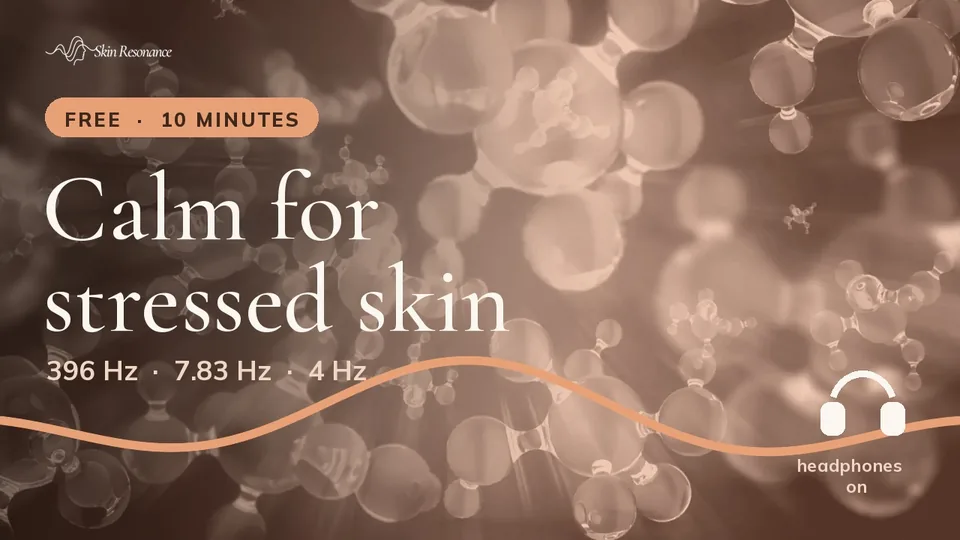
Calm for stressed skin: the free 10-minute routine
The same routine as the free try page, on YouTube: 396 Hz to settle, 7.83 Hz Schumann, then 4 Hz theta. Headphones on for steps 2 and 3.
Watch on YouTube →Sources & further reading
- de Witte M, Spruit A, van Hooren S, Moonen X, Stams GJ. Effects of music interventions on stress-related outcomes: a systematic review and two meta-analyses. Health Psychology Review 2020;14(2):294–324. PubMed
- Bradt J, Dileo C, Shim M. Music interventions for preoperative anxiety. Cochrane Database of Systematic Reviews 2013;(6):CD006908. Cochrane
- Goldsby TL, Goldsby ME, McWalters M, Mills PJ. Effects of singing bowl sound meditation on mood, tension, and well-being: an observational study. Journal of Evidence-Based Complementary & Alternative Medicine 2017;22(3):401–406. PMC
- Rio-Alamos C, Montefusco-Siegmund R, Cañete T, Sotomayor J, Fernandez-Teruel A. Acute relaxation response induced by Tibetan singing bowl sounds: a randomized controlled trial. European Journal of Investigation in Health, Psychology and Education 2023;13(2):317–330. PMC
- Stanhope J, Weinstein P. The human health effects of singing bowls: a systematic review. Complementary Therapies in Medicine 2020;51:102412. PubMed
- Cai Y, et al. Therapeutic effects of singing bowls: a systematic review of clinical studies. Integrative Medicine Research 2025;14(2):101144. PubMed
- Garcia-Argibay M, Santed MA, Reales JM. Efficacy of binaural auditory beats in cognition, anxiety, and pain perception: a meta-analysis. Psychological Research 2019;83(2):357–372. PubMed
- Ingendoh RM, Posny ES, Heine A. Binaural beats to entrain the brain? A systematic review of the effects of binaural beat stimulation on brain oscillatory activity. PLoS ONE 2023;18(5):e0286023. PMC
Elsewhere on the web
- Cochrane: music interventions for preoperative anxiety, the full review with plain-language summary.
- Global Wellness Summit: The Rise of Neurowellness, the 2026 trend report that put sound and nervous-system regulation in the same sentence.
- The Skin Resonance YouTube channel, where the free routine runs as a 10-minute video with the tones described here.
Skin Resonance is a wellness web app, not a medical device, and does not diagnose, treat or cure any condition. For a diagnosed skin condition, please see a dermatologist.
Frequently asked
Does sound healing actually work?+
Single sessions of singing bowls and of binaural beats have produced measurable falls in anxiety and tension and rises in heart rate variability in small trials, the best of them randomised. Two systematic reviews call the evidence limited and promising, and a large trial is the next step.
Can sound heal or improve skin directly?+
Not yet measured directly. The link on this site runs through the nervous system: a calmer body runs lower cortisol and inflammation, and skin repairs itself better in that state.
Do I need singing bowls to do it at home?+
No. The things the trials share are a fixed duration, lying still, and steady sound that does not demand attention. A bowl struck once a minute works; so does a low sustained tone through headphones. Binaural beats need headphones, since each ear must hear a different tone.
How long and how often?+
Twenty minutes is a reasonable floor, since longer exposure worked better in the meta-analysis. Keep the volume low. Repeat at the same time daily for a few weeks before judging; single sessions produce the acute effects, and the habit is what shifts your resting baseline.