Menopausal skin: how falling oestrogen, broken sleep and cortisol change it, and what helps
Falling oestrogen, broken sleep and raised cortisol drive menopausal skin changes. Calmer evenings and deeper sleep let your skincare do its work again.

Your skin has changed, not in a way you can quite put your finger on, but enough that the things which used to work have stopped working quite so well. The moisturiser feels less moisturising. The glow you took for granted has thinned out, you wake looking more tired than you went to bed, and the fine lines that seemed theoretical six months ago now look settled in for the long haul.
If you’re reading this nodding, you’re probably somewhere in perimenopause or menopause. The changes you’re noticing are real, and they are not a sign that you need to try harder with your skincare.
They are driven by falling oestrogen, disrupted sleep and raised cortisol, three things that feed each other and speed up collagen loss. Skincare works on the surface of that picture. What happens underneath it, in your sleep and your nervous system, is where there is real room to help, and it is more within reach than you might expect.
How menopause changes your skin: oestrogen, sleep and cortisol
When oestrogen declines, a lot happens at once. Collagen production drops, and research published in Obstetrics & Gynecology found that women lose roughly 30% of their skin collagen in the first five years after menopause, followed by about 2% a year after that. The barrier weakens, so skin becomes drier and more reactive. Hyaluronic acid levels fall, which is why the plumpness goes, and at the same time wound healing slows and inflammation runs higher.
That’s the hormonal side, and it is where most articles stop. Menopause also reaches your skin by a second route, which is through your sleep, and this second route is the one you have most say over.
Between 40 and 60 percent of menopausal women report sleep problems. Night sweats wake you, hot flushes break up the deep stages of sleep where repair happens, and anxiety that was manageable before now keeps you staring at the ceiling. You wake exhausted, and cortisol runs higher the next day because your body didn’t get the restoration it needed. Higher cortisol then makes the following night’s sleep worse, and the cycle tightens with every round.
The link to your skin runs through delta sleep, the deepest stage, which is when growth hormone is released. That hormone is the signal that tells your fibroblasts to make collagen, so less delta sleep means less overnight collagen repair. Put that beside the oestrogen-driven decline, add cortisol breaking collagen down faster, and you have three problems that each make the others worse. The encouraging part is that the cycle can also be turned the other way, and sleep is the easiest place to start turning it.
Why skincare alone can only do so much for menopausal skin
Retinol, peptides, vitamin C, growth factors and ceramides all have their place, and several of them are useful at this stage. They also all work on the same half of the problem, which is the surface. A cream cannot reach the sleep side, bring your cortisol down, or change how much time your body spends in delta sleep.
If you’re applying a peptide serum to skin that isn’t getting its overnight repair signals, you’re working against a tide. The ingredients are doing what they can. What they are missing is the conditions they were designed to work in, the sleep quality, the cortisol levels and the repair windows that have quietly shrunk.
Supporting the underlying physiology works alongside your skincare rather than replacing it. It is the layer underneath, the one that lets everything you put on your face do its job properly, and it is a layer you can start rebuilding tonight.
What the research says about sound and menopause symptoms
There’s a small but peer-reviewed body of research on music therapy for menopausal symptoms, and it deserves a careful look, because it is more encouraging than most people expect.
The best of it comes from three randomised controlled trials. Uğurlu and colleagues published a study in Revista da Associação Médica Brasileira in 2024, with 61 menopausal women listening to music twice a day over five weeks. The intervention group showed significantly better scores on the Menopausal Symptoms Rating Scale, the Pittsburgh Sleep Quality Index, and the Beck Depression Inventory than the control group. Koçak and Varişoğlu published an earlier study in 2022 in Menopause, the official journal of The Menopause Society, finding that music therapy significantly reduced menopausal symptoms and depression. Keskin Töre and Yağmur followed in 2023, also in Menopause, showing that music improved sleep quality, menopause symptom scores, and quality of life in perimenopausal and postmenopausal women.
All three trials were controlled and peer-reviewed, and two of them appeared in the leading journal in the field. That is the kind of evidence that justifies taking sound seriously as a menopause support tool, even if it has not yet found its way into mainstream guidance.
Where binaural beats come in for sleep and cortisol
Binaural beats are a specific form of sound. When your left ear hears a tone at one frequency and your right ear hears a tone at a slightly different frequency, your brain perceives a third tone at the difference between them. If that difference falls within a brainwave range, your brain tends to entrain toward it. A difference of 2 Hz falls in the delta range, which is the frequency of deep sleep. A difference of 10 Hz sits in the alpha range, associated with calm alertness.
The research on binaural beats for sleep in general populations is encouraging. Studies have shown faster sleep onset, fewer night-time awakenings and more time in slow-wave sleep in people listening to delta-frequency binaural beats before bed, and there is separate evidence of lower cortisol after listening sessions.
No study has yet tested binaural beats on menopausal women specifically, and I would rather say that plainly. What we do have is music therapy research in menopause that stands up, and binaural beat research on the two mechanisms, sleep and cortisol, that drive the skin changes described earlier. Bringing those together in one evening session is a sensible next step from the evidence, and the calm and the deeper sleep the session is built around are the parts the research covers best.
Where the evidence stands. Music therapy for menopause has randomised controlled trial support, and binaural beats have their own research support for the sleep and cortisol pathways. Skin Resonance brings the two together. The routine is not a clinical treatment for menopause, and it does not need to be; what it gives you is a fixed evening session that helps your body reach the calm, deep-sleep conditions in which overnight repair happens. You can read the full research base behind Skin Resonance, with every cited source.
The Perimenopause and Menopause routine in the Skin Resonance app
We’ve added perimenopause and menopause as a dedicated routine in the Skin Resonance app, built from scratch for the particular mix of problems this stage brings rather than adapted from an existing one. It differs from our other routines in a few deliberate ways.
It’s longer. At 70 minutes it’s the longest routine in the app, and that is on purpose. Menopausal sleep is harder to fall into, and the body needs more time to settle into the deeper states where repair happens. The 30-minute routine that suits a younger woman winding down is not always enough when your nervous system has been running hot for six months and your sleep has been fragmented for longer.
It works both day and night. Most of our routines are built for the evening. This one works as an evening wind-down for overnight repair and also as a daytime reset after a broken night, because if you’ve been awake since 4am with hot flushes, a sleep routine at ten in the morning is not what you want. What helps then is something that settles the nervous system, brings cortisol down and gives your body a chance to recover without asking you to sleep.
It combines the stress and the sleep pathways. Our Hormonal Balance routine addresses cyclical hormonal fluctuations, the kind that return to baseline within a week, and the Ageing and Elasticity routine addresses the sleep-collagen connection in general ageing. Menopause asks for both at once, because there is a sustained nervous system load and a sleep-repair deficit running side by side. The new routine sequences the two in a single 70-minute session.
How the 70-minute menopause routine is structured
The routine runs in four stages. Schumann resonance at 7.83 Hz for grounding, alpha at 10 Hz for calm alertness and circulation (the stage that lines up with the music therapy research), a 528 Hz solfeggio tone for restoration, and a longer delta stage at 2 Hz for the sleep and collagen work. Each stage flows into the next without a jarring transition, and you can use it with your evening skincare layered in, or on its own when you simply need rest.
The Perimenopause and Menopause routine is included in the Skin Resonance app, and if you would like to feel how the sound works before you decide, the free ten-minute routine above is a good place to start.
For the sleep half of this article, an hour of descending binaural beats for bedtime.
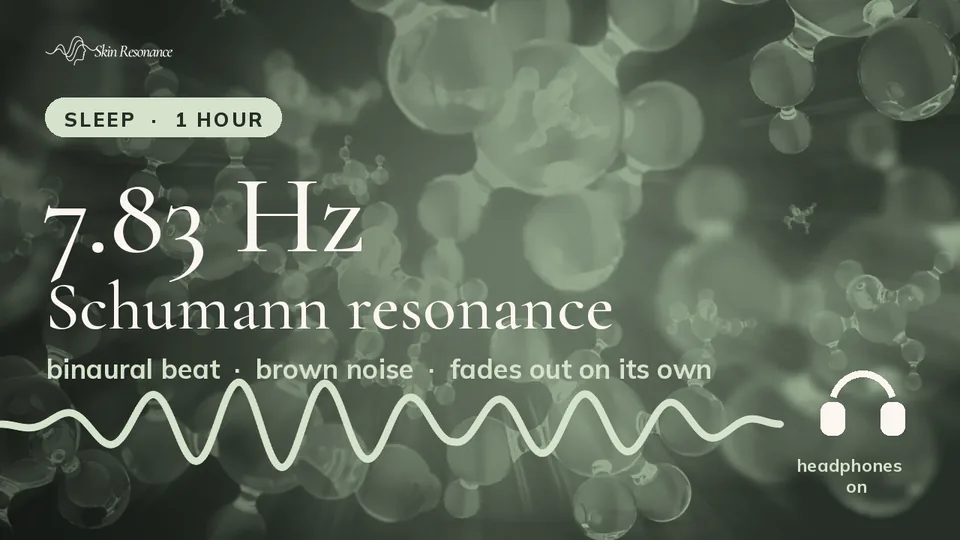
7.83 Hz sleep track: Schumann, then theta, then delta
An hour for bedtime. Fifteen minutes at 7.83 Hz, twenty at 4 Hz theta, twenty-five at 2 Hz delta, over a quiet bed of brown noise, the app's own sound engine. The screen dims after five minutes.
Watch on YouTube →Sources & further reading
- Uğurlu et al. (2024). The effect of music on menopausal symptoms, sleep quality and depression. Revista da Associação Médica Brasileira.
- Koçak & Varişoğlu (2022). The effect of music therapy on menopausal symptoms and depression. Menopause.
- Keskin Töre & Yağmur (2023). Therapeutic touch and music on sleep quality, menopausal symptoms and quality of life. Menopause.
- Brincat et al. (1987). Decrease of skin collagen content, skin thickness and bone mass in the postmenopausal woman. Obstetrics & Gynecology.
- Baker et al. (2018). Sleep problems during the menopausal transition. Nature and Science of Sleep.
- Van Cauter et al. (1996). Physiology of growth hormone secretion during sleep. Journal of Pediatrics.
- Abdi et al. (2022). The effect of binaural beats on sleep stages of healthy subjects. Digital Health.
Skin Resonance is a wellness web app, not a medical device, and does not diagnose, treat or cure any condition. For a diagnosed skin condition, please see a dermatologist.
Frequently asked
How much collagen do you lose during menopause?+
Women lose approximately 30% of their skin collagen in the first five years after menopause, followed by a slower decline of about 2% per year. This is driven primarily by falling oestrogen levels, which reduce fibroblast activity and collagen synthesis.
Why does menopause affect sleep?+
Between 40 and 60 percent of menopausal women report sleep problems. Night sweats, hot flushes, and hormonal anxiety all disrupt the deeper stages of sleep where growth hormone is released and collagen repair happens. The resulting cortisol elevation then makes the next night’s sleep worse, creating a self-reinforcing cycle.
Does sleep affect collagen production?+
Yes. Growth hormone, which signals fibroblasts to produce collagen, is released primarily during delta (deep) sleep. If you’re not reaching or sustaining deep sleep, collagen repair is reduced. During menopause, when sleep disruption is common, this compounds the collagen loss already caused by oestrogen decline.
Can sound frequencies help with menopause symptoms?+
Three randomised controlled trials, including two published in Menopause (the journal of The Menopause Society), found that music therapy significantly improved sleep quality, reduced menopausal symptoms, and lowered depression scores. Separate research supports binaural beats for cortisol reduction and sleep. No study has yet tested binaural beats specifically on menopausal women.
Why doesn’t skincare fix menopausal skin?+
Topical products work on the surface, but menopausal skin changes are driven by internal factors: falling oestrogen, disrupted sleep, and elevated cortisol. These reduce collagen production, impair barrier function, and slow repair from the inside. Supporting the underlying physiology, particularly sleep quality and nervous system regulation, works alongside skincare rather than replacing it.