Deep sleep and collagen production: how skin repairs at night, and how to get more of it
Collagen declines from your mid-twenties. Deep sleep is where your body rebuilds it, and it is the step most skincare routines leave out.

Collagen is the most abundant protein in the human body. In the skin, it provides structure, firmness, and elasticity. From your mid-twenties, natural collagen production declines by roughly 1% per year. By 50, you've lost somewhere between a quarter and a third of your skin's collagen. The visible result is sagging, thinning, fine lines, and reduced ability to bounce back from damage.
A multi-billion pound market has grown up around that decline: collagen supplements, peptide serums, retinoids, microneedling, red light therapy. Several of them have good evidence behind them. What none of them can do on their own is create the conditions in which your body makes collagen in the first place, and the biggest of those conditions is enough deep sleep.
Collagen production during deep sleep: what actually happens
Sleep is not one single state. You cycle through several stages over the night, and each does a different job. For collagen, the stage to care about is slow-wave sleep, also called deep sleep or N3. This is when your brainwaves drop to their lowest frequency (delta waves, 0.5 to 4 Hz) and your body settles into its most restorative mode.
During slow-wave sleep the pituitary gland releases its largest pulse of growth hormone (GH), and it is a big one. In men, around 70% of all GH pulses during sleep coincide with slow-wave periods, and the amount released rises and falls with the amount of deep sleep you get. Growth hormone is not only for growing children. In adults it stimulates cell reproduction, tissue repair and the making of new collagen.
A study on growth hormone-deficient adults found that GH substitution significantly increased collagen type I synthesis (measured by PICP, a blood marker) and produced measurable increases in skin thickness at both the forearm and the back of the hand. More growth hormone, in other words, means more collagen in the skin.
Growth hormone is released during deep sleep, and deep sleep declines with age, which is a large part of why collagen production declines with age too. Rather than three separate problems, this is one process with a single thread running through it, and the encouraging part is that deep sleep is something you can do a great deal to protect.
Why deep sleep declines with age (and why your skin pays for it)
The figures are striking. During your thirties, total GH secretion over a 24-hour period falls by two- to threefold. By middle age, many adults produce only a fraction of the growth hormone they did in their twenties. Because GH secretion is tied to slow-wave sleep, and slow-wave sleep itself shrinks with age, the two declines feed each other.
Less deep sleep means less growth hormone, which means less collagen being made, which over the years means thinner and less elastic skin. The decline in deep sleep that drives all this begins earlier than most people expect, in your thirties rather than at menopause or retirement. That is a good reason to start looking after your deep sleep well before the first lines appear, and the reassuring thing is that deep sleep responds to habit.
A 2025 review in Archives of Dermatological Research examined 66 studies and confirmed that sleep deprivation accelerates skin ageing and reduces collagen production. The researchers concluded that poor sleep impairs hydration, increases transepidermal water loss, and reduces elasticity. They also found that sleep quality may determine how effectively the body uses collagen, whether produced internally or taken as a supplement.
How cortisol breaks down collagen at night
Short sleep takes away the building process and adds a destructive one at the same time. When you do not sleep enough, cortisol rises, and cortisol breaks down collagen and elastin in the skin while setting off inflammatory cascades that degrade the structural proteins further.
A study in Clinical and Experimental Dermatology compared the skin of good and poor sleepers using the SCINEXA ageing scoring system. Poor sleepers scored an average of 4.4, nearly double the 2.2 average of good sleepers, showing significantly more fine lines, uneven pigmentation, reduced elasticity, and slower recovery from sunburn. The differences were in intrinsic ageing, not sun damage, meaning poor sleep was ageing the skin from the inside.
Sleep deprivation, then, works against collagen from both directions. Less is made because growth hormone is suppressed, and more is lost because cortisol is raised, and the combination does more damage than either alone. The same is true in reverse, which is the encouraging part. Sleep well and you protect collagen on both fronts at once.
How much deep sleep does skin need, and how to get more of it
In healthy young adults, slow-wave sleep takes up roughly 13 to 23 per cent of the night, which is about an hour to an hour and three-quarters of an eight-hour sleep. The 2004 meta-analysis that pooled sleep-laboratory recordings from 65 studies and more than 3,500 people found that the share falls steadily through adult life, by about two percentage points a decade until around 60, with a matching rise in lighter sleep and time awake. There is no proven dose for skin, and I would rather say so than invent one. What the collagen research supports is protecting whatever slow-wave sleep your age allows, because that is the window in which growth hormone is released.
The habits with measured effects on slow-wave sleep are unglamorous. Caffeine reduces it even when taken six hours before bed: a controlled study gave 400 mg at bedtime, three hours before and six hours before, and all three cut recorded sleep by more than an hour, though people underestimated the loss from the six-hour dose. Alcohol deepens the first half of the night and then fragments the second, with less REM overall at anything beyond a small dose, which is why a nightcap feels as if it works and does not. Heat works against deep sleep too: reviews of the thermal environment and sleep find that a warm bedroom increases wakefulness and reduces both slow-wave and REM sleep, so a cool room, around 18°C, and light layers do more than most people expect. A bout of exercise earlier in the day adds a little slow-wave sleep that night in the pooled data, and exercising regularly lengthens and consolidates sleep overall, alongside the consistent bed and wake times every sleep clinic asks for first.
Sound can act on the slow waves themselves. In a 2013 study in Neuron, quiet tones played in time with the brain's slow oscillations during deep sleep made the oscillations larger and improved overnight memory, and a 2017 study repeated the effect in older adults, whose slow waves are smaller to begin with. Those experiments used precisely timed pulses in a laboratory; the app's sleep track is a bedtime soundscape rather than a laboratory protocol and does not set out to reproduce them. What they show is that the deep-sleep rhythm responds to sound at all, which is the premise the next section builds on.
Delta brainwaves, binaural beats, and slow-wave sleep
Deep sleep is where collagen is made, and deep sleep is defined by delta brainwaves at 0.5 to 4 Hz. The natural next question is whether anything can help the brain move into that delta-dominant state more easily, and this is where sound comes in.
Binaural beats at delta frequencies are the most studied option. When two tones at slightly different frequencies are played through headphones, the brain perceives a third tone at the difference between them. A 2 Hz binaural beat, for instance, falls in the delta range and corresponds to the brainwave pattern of deep sleep.
A 2022 pilot study published in Digital Health found that participants who listened to delta binaural beats (3 Hz) for 90 minutes before sleep reported improved sleep quality, fewer awakenings, and greater sleep satisfaction after one week. The researchers suggested that the results pointed to increased delta activity due to brainwave entrainment.
A 2024 study in Scientific Reports found that binaural beats at very low frequencies (0.25 Hz) shortened the time it took participants to reach slow-wave sleep during naps. Both the lighter N2 and deeper N3 sleep stages were reached more quickly compared to the control condition.
A separate 2024 study published in Sleep (Oxford Academic) tested dynamic binaural beats in the delta range (0-3 Hz) and found they influenced delta power during sleep, confirming that these frequencies can affect the specific brainwave activity associated with the deepest, most restorative sleep stages.
The evidence chain from delta sleep to collagen
Growth hormone is released mainly during slow-wave (delta) sleep. It stimulates collagen type I synthesis and increases skin thickness. Sleep deprivation reduces GH secretion and speeds up collagen breakdown through cortisol. Delta-frequency binaural beats can raise delta brainwave activity and may help the transition into deeper sleep.
Each link in that chain has published research behind it. The chain as a whole, from listening to delta binaural beats before bed to a measurable rise in collagen, has not yet been tested in a single study, and I would rather say that plainly. What the research does show is that the sleep end of the chain is where sound can help, and the sleep end is where the collagen gets made.
What this means for your evening skincare routine
Most anti-ageing advice is about what you put on your skin: retinol at night, vitamin C in the morning, SPF during the day, collagen peptides with breakfast. All of these are sensible, and they work best when the hormonal conditions your body needs for collagen synthesis are in place underneath them.
Deeper sleep is the foundation the rest sits on, alongside topical skincare rather than in place of it. When you spend more of the night in slow-wave sleep and your growth hormone secretion is at its best, every serum, device and supplement is working on stronger ground.
The "Ageing and elasticity" routine in Skin Resonance was designed around this specific chain. It uses delta-range frequencies to support the transition into deep, restorative states before sleep. The With Skincare level adds timing for red light masks, which have their own evidence base for stimulating collagen, and microcurrent devices, creating a layered approach where the sound supports the internal conditions while the tools work at the surface.
The custom routine builder lets you set your available time and select the tools you own. The app builds a session around your schedule. Even a 20-minute pre-sleep routine using delta frequencies and a soundscape is a meaningful addition to your evening.
The free 10-minute routine is the easiest way to feel how it works. It uses calming frequencies from the Stressed, Breakout-Prone sequence rather than the ageing routine described here, so you get the sound, the pacing and the sense of an evening winding down, all before you spend anything.
How strong the evidence is for deep sleep, binaural beats and collagen
The relationship between deep sleep, growth hormone and collagen is well established and not at all speculative. GH secretion during slow-wave sleep has been documented since the 1960s, the role of GH in collagen synthesis has been confirmed in controlled trials, and the damage that sleep deprivation does to skin structure has been measured and published in peer-reviewed dermatology journals.
The newer research on delta binaural beats and sleep is early and pointing the right way. The studies so far are small and their designs vary, so I do not claim that a 2 Hz binaural beat will measurably raise your collagen production. What I can say with confidence is that deeper, better-quality sleep is one of the best-evidenced things you can do for your skin as you age, and that delta-frequency sound is a gentle, low-risk way to help your body get there.
If you already spend money on collagen supplements, retinol or professional treatments, it makes sense to look at your sleep alongside them. Those things do work, and they work better when your body is spending enough of the night in the deep, restorative states where collagen is made. Twenty minutes of delta sound at the end of the evening is a small and pleasant way to give it that chance.
The last twenty-five minutes of this track sit at 2 Hz, the delta rhythm this article is about. Headphones on, lights low.
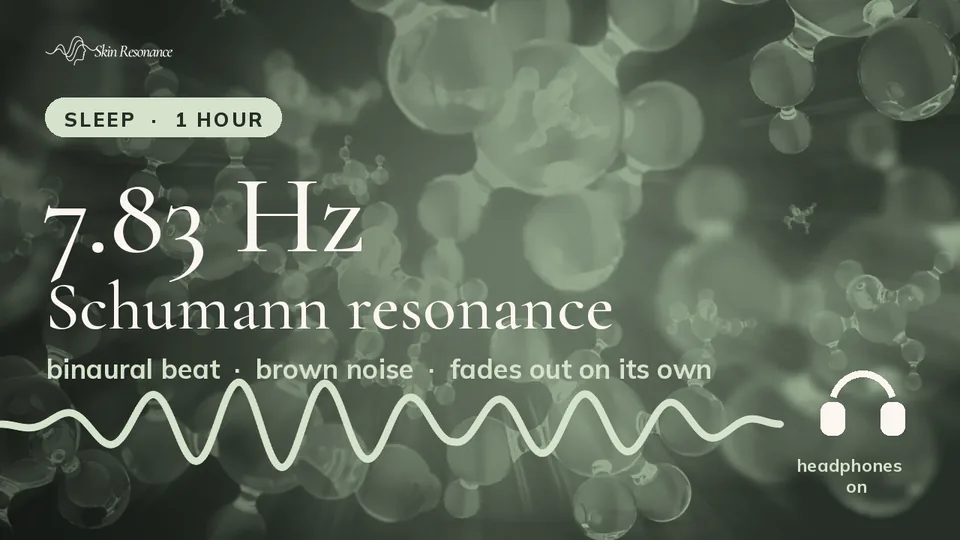
7.83 Hz sleep track: Schumann, then theta, then delta
An hour for bedtime. Fifteen minutes at 7.83 Hz, twenty at 4 Hz theta, twenty-five at 2 Hz delta, over a quiet bed of brown noise, the app's own sound engine. The screen dims after five minutes.
Watch on YouTube →Sources & further reading
- Van Cauter et al. (1996). "Physiology of growth hormone secretion during sleep." Journal of Pediatrics. PubMed: 8627466
- Oesser & Seifert (1997). "Growth hormone substitution in growth hormone-deficient adults: effects on collagen type I synthesis and skin thickness." Experimental and Clinical Endocrinology & Diabetes. PubMed: 8886750
- Oyetakin-White et al. (2015). "Does poor sleep quality affect skin ageing?" Clinical and Experimental Dermatology. PubMed: 25266053
- Xerfan et al. (2025). "Can good sleep quality enhance the benefits of oral collagen supplementation in the prevention of skin aging?" Archives of Dermatological Research. PubMed: 39912934
- Greenberg & Slyer (2025). "The Sleep-Skin Axis: Clinical Insights and Therapeutic Approaches for Inflammatory Dermatologic Conditions." Dermato. doi:10.3390/dermato5030013
- Kahan et al. (2010). "Can poor sleep affect skin integrity?" Medical Hypotheses. PubMed: 20678867
- Abdi et al. (2022). "The effect of auditory stimulation using delta binaural beat for a better sleep and post-sleep mood: A pilot study." Digital Health. PMC: 9125055
- Fan et al. (2024). "Binaural beats at 0.25 Hz shorten the latency to slow-wave sleep during daytime naps." Scientific Reports (Nature). doi:10.1038/s41598-024-76059-9
- Lee et al. (2024). "Effect of dynamic binaural beats on sleep quality: a proof-of-concept study with questionnaire and biosignals." Sleep (Oxford Academic). doi:10.1093/sleep/zsae097
- Ohayon et al. (2004). "Meta-analysis of quantitative sleep parameters from childhood to old age in healthy individuals: developing normative sleep values across the human lifespan." Sleep. PubMed: 15586779
- Drake et al. (2013). "Caffeine effects on sleep taken 0, 3, or 6 hours before going to bed." Journal of Clinical Sleep Medicine. PubMed: 24235903
- Ebrahim et al. (2013). "Alcohol and sleep I: effects on normal sleep." Alcoholism: Clinical and Experimental Research. PubMed: 23347102
- Okamoto-Mizuno & Mizuno (2012). "Effects of thermal environment on sleep and circadian rhythm." Journal of Physiological Anthropology. doi:10.1186/1880-6805-31-14
- Kredlow et al. (2015). "The effects of physical activity on sleep: a meta-analytic review." Journal of Behavioral Medicine. PubMed: 25596964
- Ngo et al. (2013). "Auditory closed-loop stimulation of the sleep slow oscillation enhances memory." Neuron. PubMed: 23583623
- Papalambros et al. (2017). "Acoustic enhancement of sleep slow oscillations and concomitant memory improvement in older adults." Frontiers in Human Neuroscience. doi:10.3389/fnhum.2017.00109
Skin Resonance is a wellness web app, not a medical device, and does not diagnose, treat or cure any condition. For a diagnosed skin condition, please see a dermatologist.
Frequently asked
Does deep sleep increase collagen production?+
Yes. During slow-wave (deep) sleep, the pituitary gland releases its largest pulse of growth hormone, which directly stimulates collagen type I synthesis. Research on growth hormone-deficient adults showed that restoring GH levels produced measurable increases in collagen markers and skin thickness. Less deep sleep means less growth hormone, which means less collagen.
What are delta waves and why do they matter for skin?+
Delta waves are the slowest brainwaves, oscillating between 0.5 and 4 Hz. They dominate during the deepest stage of sleep (N3 or slow-wave sleep), which is when the body releases the most growth hormone. Because growth hormone drives collagen production and tissue repair, the time you spend in delta-dominant sleep directly affects your skin's ability to rebuild itself overnight.
Can binaural beats help you get deeper sleep?+
Emerging research suggests they can support it. A 2024 study in Scientific Reports found that binaural beats at very low frequencies shortened the time to reach slow-wave sleep. A separate 2024 study in Sleep (Oxford Academic) confirmed that delta-range binaural beats influenced delta brainwave power during sleep. The evidence is early and pointing the right way, though most studies so far are small.
Does lack of sleep age your skin faster?+
Research published in Clinical and Experimental Dermatology found that poor sleepers scored nearly double on an intrinsic ageing scale compared to good sleepers, showing more fine lines, reduced elasticity, and slower recovery from UV exposure. Sleep deprivation also raises cortisol, which actively breaks down collagen and elastin. A 2025 review of 66 studies confirmed that poor sleep accelerates skin ageing and reduces collagen production.
At what age does deep sleep start to decline?+
Deep sleep begins declining in your thirties. By this age, total growth hormone secretion over 24 hours decreases by two- to threefold compared to your twenties. Since growth hormone secretion is tied to slow-wave sleep, and both decline together, the impact on collagen production starts earlier than most people expect - well before menopause or visible ageing signs appear.
How much deep sleep do you need for your skin?+
There is no proven dose for skin. In healthy young adults slow-wave sleep makes up roughly 13 to 23 per cent of the night, about an hour to an hour and three-quarters in eight hours, and the share falls by about two percentage points a decade through adult life. What the collagen research supports is protecting the deep sleep your age allows, since growth hormone is released in that stage. The habits with measured effects are a cool bedroom, caffeine finished at least six hours before bed and earlier if sleep is light, little or no alcohol in the evening, regular exercise earlier in the day, and consistent sleep and wake times.