Slow breathing: ten minutes at 5.5 breaths a minute, and why it reaches your skin
Most adults breathe twelve to twenty times a minute at rest. Slowed to five or six, the breath falls into step with the reflex that links heart rate and blood pressure, and the body's rest-and-repair side takes over. The Slow breathing routine in the app is ten minutes at that pace: a circle to follow, spoken guidance you can switch off, and the 7.83 Hz bed from the other routines underneath. It is the shortest routine in the app and the one to use before any of the others.
Breathwork has become a word for a lot of different things, from fast, forceful styles that leave people tingling to breath-holds in cold water. This routine is none of those. It is quiet nasal breathing at a fixed slow pace, the kind the clinical heart-rate-variability work is built on, and the pace is the whole point.
What slow breathing does in the body
Every breath nudges heart rate: it rises a little on the in-breath and falls on the out-breath. Blood pressure follows its own slower rhythm, about once every ten seconds, through the baroreflex, the pressure sensors in the neck and chest that tell the heart to speed up or slow down. Breathe at around six breaths a minute and the two rhythms line up. Heart-rate variability, the amount the heart speeds and slows with each breath, rises to its highest, and the vagal, rest-and-repair side of the nervous system is doing the steering. Lehrer and Gevirtz set the mechanism out in Frontiers in Psychology in 2014, and it is why heart-rate-variability biofeedback trains people to breathe at exactly this rate.
The 5.5 figure is not a round number chosen for the look of it. A 2014 study compared breathing rates and in-to-out ratios and found that 5.5 breaths a minute, with the in-breath and out-breath equal, produced the highest heart-rate variability (Lin and colleagues, International Journal of Psychophysiology). It is the same pace Brown and Gerbarg teach as coherent breathing.
What that does to how you feel has been measured. In a trial of 95 adults, fifteen minutes at their resonance rate left people with lower systolic blood pressure during and after a stress task and higher positive mood than those breathing one breath a minute faster or sitting quietly (Steffen and colleagues, Frontiers in Public Health, 2017). A systematic review of fifteen studies of breathing below ten breaths a minute found the same pattern across the literature: higher heart-rate variability, a shift toward the parasympathetic side, and reports of more comfort, relaxation and alertness with less arousal, anxiety and anger (Zaccaro and colleagues, Frontiers in Human Neuroscience, 2018). Across twelve randomised trials with 785 adults, breathwork of various kinds lowered self-reported stress by a small-to-medium amount, with similar results for anxiety and low mood (Fincham and colleagues, Scientific Reports, 2023). The trials are small and the effects are modest, which is what ten minutes of breathing should be expected to show, and they point the same way.
Why a breathing exercise is on a skincare site
The link runs through the stress response. In a study of 25 healthy women, a stressful interview delayed the recovery of the skin barrier after it had been disrupted, with cortisol, noradrenaline and several inflammatory cytokines raised at the same time, and a night without sleep did the same (Altemus and colleagues, Journal of Investigative Dermatology, 2001). Skin that repairs its barrier slowly reacts more, holds water less well and shows stress sooner. Slow breathing is the quickest lever most people have on that system, it costs nothing, and it can be done lying down with a mask on.
The 7.83 Hz bed under the breathing is the binaural beat that opens the app's other routines, 108 Hz in one ear and 115.83 Hz in the other. Binaural beats in this range were found to reduce anxiety across trials in a 2019 meta-analysis (Garcia-Argibay and colleagues, Psychological Research). The beat needs headphones; the breathing does not.
How to breathe with the circle
The circle grows for five and a half seconds and shrinks for five and a half. Breathe in through the nose as it grows and out through the nose as it shrinks, lightly, with the belly rather than the chest. A slow breath is a small one: the air you take in over five seconds at rest is no more than you take in over two, so if you fill your lungs at this pace you will feel light-headed. Lips closed, jaw soft, shoulders down. Those are the habits the breathwork teachers repeat, and the routine's cues remind you of them one at a time.
The first four breaths are shorter, 8, 9, 10 and 10.5 seconds for the full cycle, so you are led down to the pace rather than dropped into it, which is how the clinical protocols bring people to their resonance rate. The stream soundscape swells a little with each in-breath, so once you know the rhythm you can close your eyes and follow it by ear, and the circle shifts from sage to clay as the breath fills it, so the phase reads at the edge of your vision when your eyes soften.
The Slow breathing routine in the app
Ten minutes. A breathing circle with the words breathe in and breathe out inside it, Sophie's spoken guidance at the start, halfway and the end (switch it off and the circle leads alone), the 7.83 Hz bed, the stream swelling with each breath, and a full-screen view for lying down. The With skincare version times it to a mask, serum or compress, so the breathing happens while the product works.
Get the app →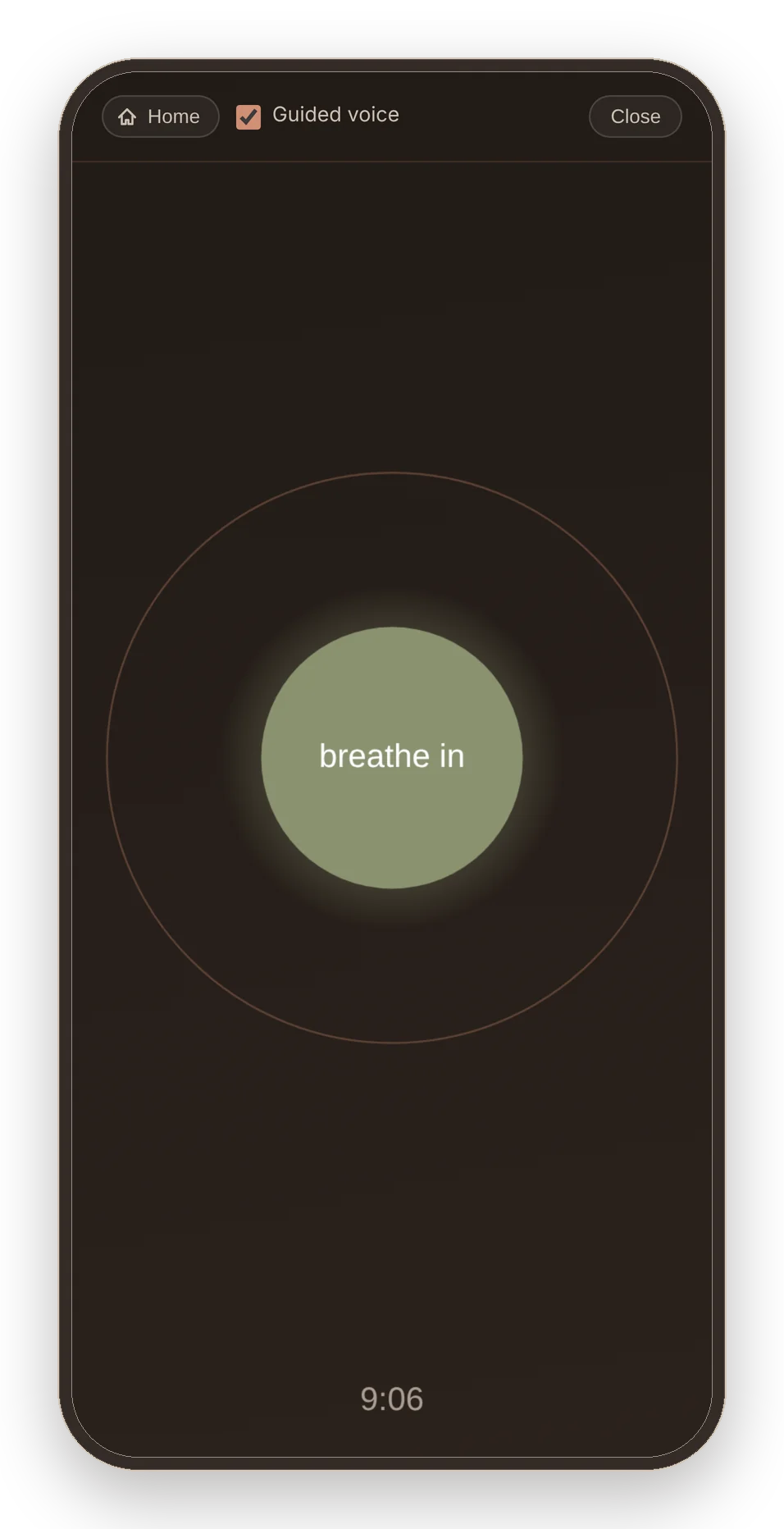
When to use it
Before a treatment, so the mask or the red light session starts on a settled system rather than a racing one. After a hard day, as the first thing in an evening routine, where ten minutes is enough to change the state the rest of the evening runs in. Or on its own, sitting at a desk, when the pace of the day has got into the jaw and the shoulders. It is the routine to run before any of the longer ones in the app: the breathing settles the body, and the twenty- to fifty-five-minute frequency routines keep it there.
Frequently asked
What is coherent breathing?+
Breathing at about five to six breaths a minute with the in-breath and out-breath the same length. At that pace the breath falls into step with the baroreflex, the pressure reflex between heart and blood vessels, and heart-rate variability rises to its highest. Heart-rate-variability biofeedback calls the same thing resonance frequency breathing. The routine uses 5.5 seconds in and 5.5 seconds out, which is 5.5 breaths a minute.
Do I need headphones for the breathing routine?+
Only for the 7.83 Hz binaural beat, which exists only when each ear gets its own tone. The breathing, the circle, the spoken guidance and the stream soundscape work the same on a speaker, so if there are no headphones to hand, press start anyway.
Is 5.5 seconds too slow for a beginner?+
The first four breaths of the routine are shorter, 8, 9, 10 and 10.5 seconds for the full cycle, so you are led down to the pace rather than dropped into it. If a breath feels long, breathe lighter rather than deeper: a slow breath is a small, quiet one, and a big one at this pace can make you light-headed. If that happens, let a few breaths go at their own pace and come back to the circle when you are ready.
Can slow breathing help my skin?+
Indirectly, through the stress response. In a study of 25 healthy women, a stressful interview delayed the recovery of the skin barrier after it had been disrupted, with cortisol, noradrenaline and several inflammatory cytokines raised at the same time. Slow breathing is one of the quickest ways to settle that system, and the trials show small-to-medium reductions in stress and anxiety. It will not clear a breakout, but it changes the conditions your skin repairs in.
Is slow breathing safe for everyone?+
For most people, yes: it is quiet, nasal breathing at a slow pace, not breath-holding or hyperventilation. If you have a diagnosed heart, lung or anxiety condition, or you are pregnant, speak to your clinician before changing how you breathe, and stop if you feel dizzy.
Skin Resonance is a wellness web app, not a medical device, and does not diagnose, treat or cure any condition. For a diagnosed heart, lung or anxiety condition, or if you are pregnant, speak to your clinician before changing how you breathe.