Your treatment made the stimulus. Recovery makes the result.
Every collagen treatment, laser, microneedling, peel or microcurrent, works by starting a repair process that your own cells finish over the following days and weeks. Research shows stress measurably slows that repair. Supporting the recovery window is what turns a fine result into the one you were hoping for.
Whether you have had a laser session, microneedling, a peel or a microcurrent treatment, the device has done its part by creating a stimulus. The result you paid for is built afterwards, over days and weeks, by your own cells, and how well they build depends on the state your body is in while they work. This page is about that second half of every treatment, which is the half you can support at home.
How laser and microneedling results keep building after the session
At-home lasers and clinic treatments work by triggering a repair cascade, in which light or controlled injury signals fibroblasts to synthesise new collagen. The research on the stimulus side is solid. A 2024 study in Lasers in Medical Science confirmed low-level laser therapy increases type I collagen synthesis, and a 2024 systematic review in the Journal of Cosmetic Dermatology found commercial devices produce significant improvements in wrinkle severity and collagen density. The remodelling those treatments start does not stop when you put the device down; it runs on in the background for weeks.
What stress does to healing
A 2025 review in Clinical, Cosmetic and Investigational Dermatology examined stress and collagen-dependent treatments directly. Chronic stress impairs fibroblast function, weakens tissue regeneration and reduces collagen production, and the authors concluded that stress management should be built into treatment protocols. The mechanism is cortisol, which suppresses the repair signals the treatment relies on, slows fibroblast migration to the treatment site, and raises the enzymes that break collagen down. In a classic wound-healing study, participants with higher stress and morning cortisol healed a standardised biopsy markedly more slowly, and stress was one of the strongest predictors of healing speed the researchers found. The encouraging side of this is that stress is something you can lower, and doing so around a treatment gives the collagen response a clearer run.
How sleep and calm after a treatment build the collagen result
Once you see it this way, the days after a treatment become part of the treatment. A calm, well-slept body with good circulation delivers the oxygen, nutrients and repair signals the treated skin needs, and a stressed body delivers less of all three. Growth hormone, the main driver of the collagen synthesis your session triggered, is released during deep sleep, so the nights after a treatment carry a large share of the result. Protecting those nights is one of the simplest ways to get more from a session you have already paid for.
The Post-Treatment Recovery routine
Gentle restoration frequencies to support the calm, rested state your skin repairs in, for the evenings after a laser, microneedling, peel or microcurrent session. Twenty minutes, lying down, letting the result form.
Try the free taster →A post-treatment recovery protocol for the days after a session
- Treat the two or three nights after a session as protected: earlier to bed, consistent times, a cool room. Deep sleep is when the collagen response runs.
- Keep skincare minimal and barrier-supporting: gentle cleanse, a ceramide moisturiser, and strict SPF while skin is vulnerable.
- Avoid stacking stressors: no new actives, no second treatment, and ideally no bruising deadlines in the same window.
- Use a wind-down or restoration routine each evening to keep cortisol low while the repair cascade works.
- Give results their full timeline. Collagen remodelling runs over weeks, so judge a treatment at week six rather than day three.
For the full research on why your state shapes your results, read at-home lasers and nervous system calm, or what to do during a red light session.
For the nights after a treatment, an hour of descending binaural beats to protect the repair window.
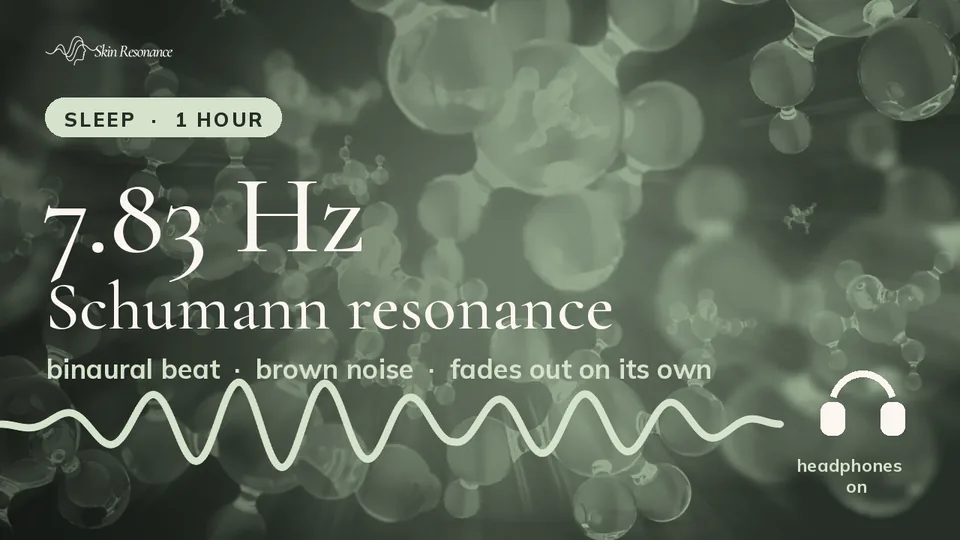
7.83 Hz sleep track: Schumann, then theta, then delta
An hour for bedtime. Fifteen minutes at 7.83 Hz, twenty at 4 Hz theta, twenty-five at 2 Hz delta, over a quiet bed of brown noise, the app's own sound engine. The screen dims after five minutes.
Watch on YouTube →Frequently asked
What should I do after a laser or microneedling session?+
Protect the recovery window. Keep skincare gentle and minimal with strict SPF, hold off on new actives or stacked treatments, and above all sleep well for the following nights, since deep sleep drives the collagen response your session triggered. Calm evenings belong in the protocol alongside the SPF.
Why are my at-home device results disappointing?+
Often the device is doing its job and the recovery state around it needs more support. A 2025 review found chronic stress impairs fibroblast function and reduces collagen production, meaning elevated cortisol can blunt the response your device is designed to trigger. Managing stress around your sessions is a real lever, and it can change what you get from the same device.
Does stress really slow skin healing?+
Yes, and the effect has been measured. In a standardised wound-healing study, participants with higher perceived stress and higher morning cortisol healed significantly more slowly, and stress was among the strongest predictors of healing speed. The same biology applies to the controlled micro-injury of cosmetic treatments, which is why a calmer recovery period helps.
How long do treatment results take to appear?+
Collagen remodelling runs over weeks rather than days. Most device studies measure outcomes at six to twelve weeks of consistent use, so judge results on that timescale, and remember the process continues between sessions, which is why the state you recover in keeps counting.
Can I combine sound routines with my device sessions?+
Yes, and they fit naturally either side of a session. A short calming routine beforehand lowers the muscle tension and cortisol that blunt device response, and a restoration routine on the evenings after supports the repair state. The app's tool-aware routines sequence this for you, so there is nothing to plan.
Skin Resonance is a wellness web app, not a medical device, and does not diagnose, treat or cure any condition. For a diagnosed skin condition, please see a dermatologist.