Cymatics: how sound draws patterns in sand and water, from Chladni's plates to building tissue with sound
The videos of salt gathering into mandalas on a humming plate show one of the oldest experiments in acoustics. Here is where it came from, why the patterns form, and how the same physics is now used to arrange living cells.

If you have spent any time around sound healing online, you will have seen the videos: a black metal plate dusted with salt, a tone that slowly rises, and the salt suddenly gathering into a star, then a lattice, then something like a cathedral window. What they show is real physics and one of the oldest experiments in acoustics. It has a name, cymatics, a history that runs through Napoleon's court and a self-taught mathematician who won a prize Napoleon set, and a quieter modern life in laboratories that now use the same physics to arrange living cells.
Chladni's sand figures: the experiment that founded acoustics
Galileo noticed something like it around 1630, and Robert Hooke saw patterns form on a bowed plate in July 1680, but the person who made it a science was Ernst Chladni, a German lawyer turned physicist and amateur musician. He clamped thin plates of glass or brass at the centre, scattered sand over them and drew a violin bow along the edge. Each time the plate sang a clear note, the sand jumped away from some regions and settled along fine, symmetrical lines. In 1787 he published the figures, 166 of them, in Entdeckungen über die Theorie des Klanges, Discoveries in the Theory of Sound, and a later book, Die Akustik, earned him the title of the father of acoustics.
In February 1809, at the Tuileries Palace, Chladni demonstrated the figures to Napoleon, who gave him 6,000 francs to publish his work in French and offered a further 3,000 francs to whoever could explain the patterns mathematically. The only person to make real progress was Sophie Germain, a self-taught mathematician who had corresponded with Gauss under a man's name because women were shut out of the academies. She entered three times, and in 1816 her memoir on the vibrations of elastic surfaces won the prize. The judges noted gaps in her mathematics, and the complete solution for a circular plate came from Gustav Kirchhoff around 1850, but her work became part of the foundations of the theory of elasticity that engineers still rely on.
Chladni's method never left the workshop. Violin and guitar makers still sprinkle powder on a finished top or back plate and drive it with a speaker, reading the pattern to judge whether the wood will resonate as they want.
Why the sand finds the still lines: standing waves and resonance
A plate, a drumskin or a bowl of water has a set of natural frequencies at which it vibrates far more readily than at any other, in the same way that a wine glass rings at one particular note. Driven at one of these frequencies, the plate resonates. Waves run out to the edges, reflect, and meet the waves still coming, and at resonance the outgoing and returning waves line up so precisely that the vibration stands still in space. This is a standing wave. Some regions swing up and down with the greatest movement, the antinodes, and between them run lines that hardly move at all, the nodes.
Sand on a moving region is thrown up and lands a little further away, again and again, until it reaches a place where nothing moves and it can rest. That is why the sand draws the nodal lines. Faraday added a detail in 1831 that delighted him: very fine powder such as lycopodium does the opposite and gathers at the antinodes, carried there by the small currents the vibrating plate sets up in the air above it.
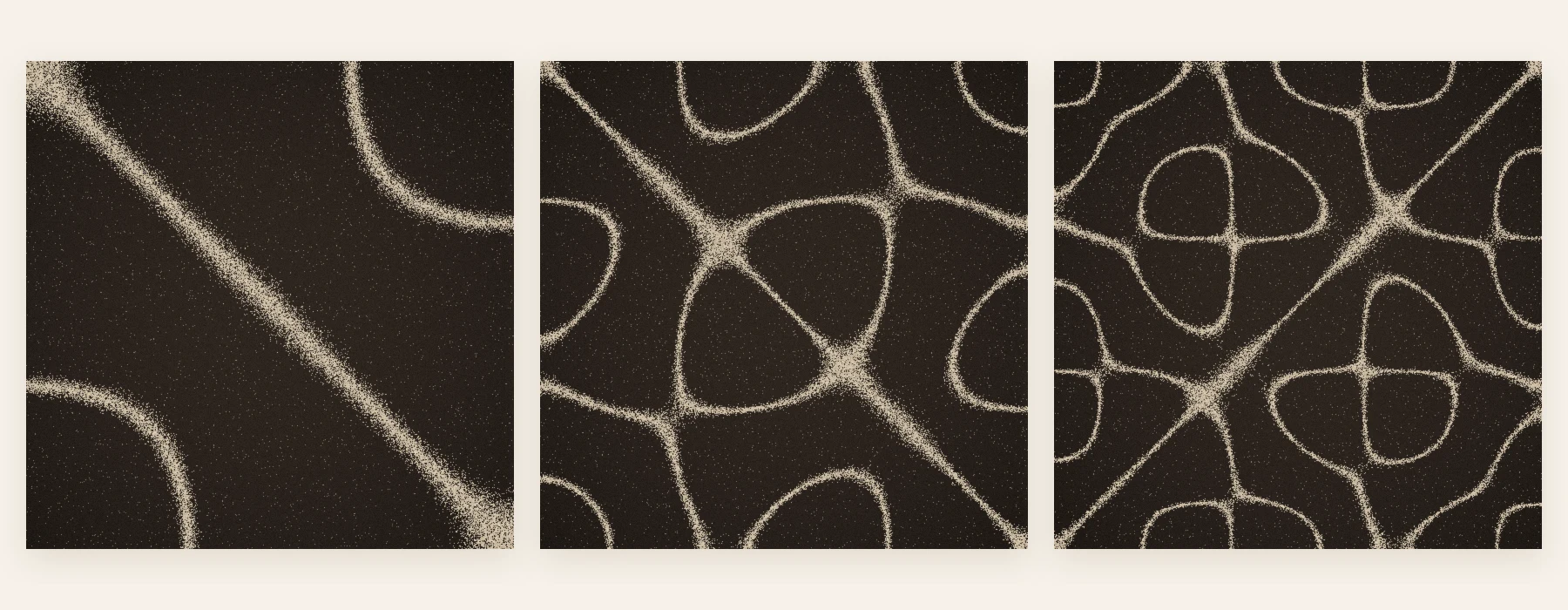
Higher natural frequencies mean shorter waves, so more of them fit across the plate, and the pattern grows more intricate as the pitch rises. Between those frequencies the plate barely resonates, and the sand simply dances and scatters until the next note brings it into a new figure. The figure belongs to the plate as much as to the sound: its shape, size, thickness, material and the point where it is held decide which frequencies it answers to and which lines stay still. The same note gives one pattern on a square plate and another on a round one, which is why there is no single shape that belongs to 432 Hz or 528 Hz. A pattern is a portrait of a particular object resonating.
Faraday's ripples and Hans Jenny's cymatics
In the same 1831 paper in the Philosophical Transactions of the Royal Society, Michael Faraday turned to liquids. A shallow layer of liquid on a vibrating plate breaks into a grid of standing ripples once the shaking is strong enough, and Faraday noticed that the ripples rise and fall at half the frequency of the plate beneath them. These Faraday waves can settle into stripes, squares, hexagons and, under the right conditions, patterns that never quite repeat. They are what you are seeing in most of the water videos online.
The word cymatics came much later, from Hans Jenny, a Swiss physician who spent the 1960s photographing what sound does to sand, liquids, pastes and powders. He drove plates and membranes with crystal oscillators, built a device he called the tonoscope so that a person could sing into a tube and see their own voice drawn in sand, and published the results in two volumes, in 1967 and 1972. He took the name from the Greek kyma, a wave. Jenny saw in the images a dynamic order rather than chaos, and it is largely through his photographs that the subject reached artists, musicians and the wellness world.
Cymatics in the laboratory: building living tissue with sound
The same physics now does careful work in tissue engineering, and this is where it starts to touch living cells. In 2014 a Stanford group led by Utkan Demirci used Faraday waves as a template that can be redrawn by changing the note. Cells, clusters of cells and tiny cell-coated beads were floated on a liquid driven at frequencies between about 44 and 200 Hz, and within around five seconds they gathered into the pattern of the standing wave, which could then be set in a gel. Fibroblasts assembled this way grew as well as untouched cells over eleven days, and nerve cells on beads formed three-dimensional neural structures within two weeks.
At Imperial College London, Molly Stevens's group uses ultrasound standing waves, far above hearing, to line cells up inside gels as they set. In 2018 they arranged muscle precursor cells into parallel rows that matured into aligned bundles of muscle fibre 120 to 150 micrometres wide, closer to the structure of real muscle than cells left to settle at random. In 2022 they did the same with cartilage cells at 6.7 MHz: the cells moved from a random scatter into lines spaced 112 micrometres apart in about twenty seconds, matching the predicted half-wavelength almost exactly, and over five weeks the collagen they made grew along the same lines, as it does in the deep layer of natural cartilage. The sound did not harm the cells in either study.
None of this is sound as music, and the frequencies and pressures are chosen with great precision. What it shows is that the old principle of Chladni's plate, that a standing wave sorts whatever rests in it into the still places and the moving ones, works on cells as well as on sand. It sits alongside the 2025 Kyoto finding, covered in Can skin hear?, that cells sense sound through the machinery they use to feel mechanical force.
What cymatics shows about sound and the body
Cymatic patterns need a plate or a layer of liquid of even thickness, driven steadily at one of its natural frequencies, and the pattern is a picture of how that particular object resonates. A body is a very different object, made of many tissues of different densities, curved and layered and full of moving fluid, so the photographs are best read as a beautiful demonstration of resonance rather than a map of what a tone does inside you. Where sound reaches the body most clearly is through the ear, as a signal the nervous system responds to: steady sound lowers stress markers in controlled trials, and lower stress and deeper sleep give the skin the conditions in which it repairs itself. That chain is set out on the science page, and it is what the routines in the app are built around.
What the photographs and the laboratory work share with a sound routine is the importance of steadiness. A pattern only forms while the frequency holds, and the June 2026 sleep and stress trial on the science page used a single beat held steady for half an hour rather than sounds that change every few seconds. The routines in the app are built the same way, one frequency at a time, long enough for the body to settle under it. The free ten-minute routine is the easiest place to start, and the app has fourteen more.
How to see cymatics at home
The water version shows Faraday's ripples. Fill a shallow dark bowl or a black baking tray with a centimetre of water and stand it directly on a speaker facing upwards: water needs the vibration passed to it through the dish, so the speaker has to be underneath it or touching it, or touching the table the dish stands on. A Bluetooth speaker lying face up is ideal for this. Play a pure tone from a free tone-generator app, starting around 20 Hz and sliding slowly upwards, or one of the app's steady tones, and shine a lamp across the surface at a low angle. At certain frequencies the ripples lock into a still pattern of rings or a grid; low tones give large, slow ripples and higher tones give finer ones that need the raking light to show. A light dusting of cornflour on the surface makes the pattern easier to see, because the powder collects along its lines. It soaks in after a few minutes, so add it just before you start.
The sand version is Chladni's experiment in a kitchen, and it works well with the Skin Resonance app played from your phone through a Bluetooth speaker. A small portable speaker, a Bose or similar, has far more low end than a phone's own speaker and gives stronger, cleaner patterns. Stretch cling film tightly over a bowl, like a drum, and sprinkle a pinch of fine salt or sugar on it. A membrane picks sound up through the air, so the speaker can sit beside the bowl or just below it, a few centimetres away, rather than touching it. In the app, choose Speakers, open Sound mix, turn the noise bed down to nothing and the soundscape off, and play a step with a steady tone: the first step of the free ten-minute routine is a 396 Hz tone, and the solfeggio steps in the other routines work the same way. Some tones will send the salt into clean lines and others will leave it dancing, and which ones work depends on the size of your bowl and how tightly the film is stretched, which is the plate deciding the pattern, just as Chladni found. Keep the volume moderate, especially with children nearby; the patterns appear at levels that are comfortable to listen to.
Sources & further reading
- Chladni, E. F. F. (1787). Entdeckungen über die Theorie des Klanges. Leipzig: Weidmanns Erben und Reich.
- Stöckmann, H.-J. (2007). Chladni meets Napoleon. European Physical Journal Special Topics, 145, 15-23. epjst.epj.org/articles/epjst/abs/2007/06/st145002
- Ullmann, D. (2007). Life and work of E. F. F. Chladni. European Physical Journal Special Topics, 145, 25-32. link.springer.com/article/10.1140/epjst/e2007-00144-5
- American Physical Society (2017). This month in physics history: July 1680, first experiments on Chladni figures. aps.org/apsnews/2017/07/first-experiments-chladni-figures
- American Physical Society (2004). This month in physics history: May 1816, Sophie Germain wins the Paris Academy prize. aps.org/apsnews/2004/05/this-month-in-physics-history
- Faraday, M. (1831). On a peculiar class of acoustical figures; and on certain forms assumed by groups of particles upon vibrating elastic surfaces. Philosophical Transactions of the Royal Society of London, 121, 299-340. jstor.org/stable/107936
- Jenny, H. (1967, 1972). Kymatik / Cymatics: The Structure and Dynamics of Waves and Vibrations, volumes I and II. Basel: Basilius Presse. Reissued in one volume, Macromedia, 2001.
- Chen, P., Luo, Z., Güven, S., Tasoglu, S., Ganesan, A. V., Weng, A., & Demirci, U. (2014). Microscale assembly directed by liquid-based template. Advanced Materials, 26(34), 5936-5941. pmc.ncbi.nlm.nih.gov/articles/PMC4159433
- Armstrong, J. P. K., et al. (2018). Engineering anisotropic muscle tissue using acoustic cell patterning. Advanced Materials, 30(43), 1802649. doi.org/10.1002/adma.201802649
- Armstrong, J. P. K., Pchelintseva, E., Treumuth, S., et al. (2022). Tissue engineering cartilage with deep zone cytoarchitecture by high-resolution acoustic cell patterning. Advanced Healthcare Materials, 11(24), 2200481. pmc.ncbi.nlm.nih.gov/articles/PMC7614068
- Kumeta, M., Otani, M., Toyoda, M., & Yoshimura, S. H. (2025). Acoustic modulation of mechanosensitive genes and adipocyte differentiation. Communications Biology, 8, 595. nature.com/articles/s42003-025-07969-1
Skin Resonance is a wellness web app, not a medical device, and does not diagnose, treat or cure any condition. For a diagnosed skin condition, please see a dermatologist.
Frequently asked
What is cymatics?+
Cymatics is the study of the visible patterns that sound and vibration make in sand, powder, water and other materials. A plate or liquid driven at one of its natural frequencies forms a standing wave, and particles gather along the lines that stay still. The experiment goes back to Ernst Chladni in 1787; the word was coined by the Swiss physician Hans Jenny in the 1960s, from the Greek kyma, a wave.
Why do the patterns change when the frequency changes?+
Each plate or dish of liquid has its own set of natural frequencies, and each one produces a different standing wave. Higher frequencies mean shorter waves, so more nodal lines fit across the surface and the pattern becomes more intricate. Between those frequencies the surface barely resonates and the sand scatters. The shape, size, thickness and material of the plate decide which frequencies it answers to, so the same note gives different patterns on different plates.
Is cymatics used in science today?+
Yes. Instrument makers use Chladni's method to tune violin and guitar plates, and tissue engineers use standing waves to arrange living cells. Stanford researchers used Faraday waves at 44 to 200 Hz to assemble cells and cell clusters into patterns within seconds, and Imperial College London has used ultrasound standing waves to line up muscle and cartilage cells so the tissue they grow is organised like the real thing.
How can I see cymatic patterns at home?+
For ripples in water, stand a shallow dark bowl with a centimetre of water directly on an upward-facing speaker, light it from a low angle and slide a pure tone slowly upwards from about 20 Hz with a free tone-generator app; a light dusting of cornflour makes the lines easier to see. For sand patterns, stretch cling film over a bowl, add a pinch of fine salt and set a Bluetooth speaker beside it. The Skin Resonance app, played from your phone through the speaker, works for this on Speakers with the noise bed turned down and the soundscape off: the first step of the free routine is a steady 396 Hz tone. Keep the volume at a comfortable level.